How to Write a Technical Specification for a Container Yard Crane
A reliable container yard crane specification must define the operating concept before listing crane parameters. Buyers should state the RTG or RMG layout, container mix, stacking pattern, rated load under spreader, target cycle, duty, speeds, power system, wind and corrosion conditions, control or automation scope, civil interfaces, safety functions, guaranteed performance and acceptance tests.
The Direct Answer: Write the Yard Requirement Before the Crane Requirement
A container yard crane is part of a logistics system, not an isolated lifting machine. Its correct span, stacking height, speeds, power architecture and automation level depend on the yard block, truck or rail interface, expected container flow and operating philosophy. Begin the technical specification with a dimensioned yard plan and a defined operating cycle. Then convert those process requirements into crane parameters and measurable guarantees.
The specification should separate three kinds of information: buyer-supplied site and process data, mandatory crane performance, and supplier-proposed engineering. This prevents bidders from hiding assumptions inside a general catalog offer and makes quotation comparison more reliable.
| Specification Section | Buyer Must Define | Supplier Must Confirm | Contract Output |
|---|---|---|---|
| Operating basis | Container types, yard layout, moves, stacking, traffic and operating hours. | Proposed RTG/RMG configuration and operating sequence. | Approved design-basis schedule. |
| Geometry and capacity | Stacking pattern, lanes, clearances and heaviest operating load. | Span, cantilever, lift, overall envelope, reactions and spreader arrangement. | General arrangement and interface drawings. |
| Performance | Required production cycle, availability basis and handling modes. | Speeds, accelerations, simultaneous motions, duty and guaranteed output. | Performance-guarantee schedule and test method. |
| Power and environment | Power availability, weather, wind, temperature, corrosion and site conditions. | Selected power system, protection, energy demand and operating limits. | Utility schedule and environmental design basis. |
| Controls and automation | Cabin, remote or automated operation and terminal-system interfaces. | Architecture, sensors, communications, diagnostics, safety logic and recovery modes. | Functional description and interface-control document. |
| Testing and handover | Acceptance responsibilities, test loads, site access and training expectations. | FAT/SAT procedures, commissioning plan, documentation and service scope. | Accepted crane, records, training and warranty start. |

1. Define the Operating Basis and Select RTG or RMG
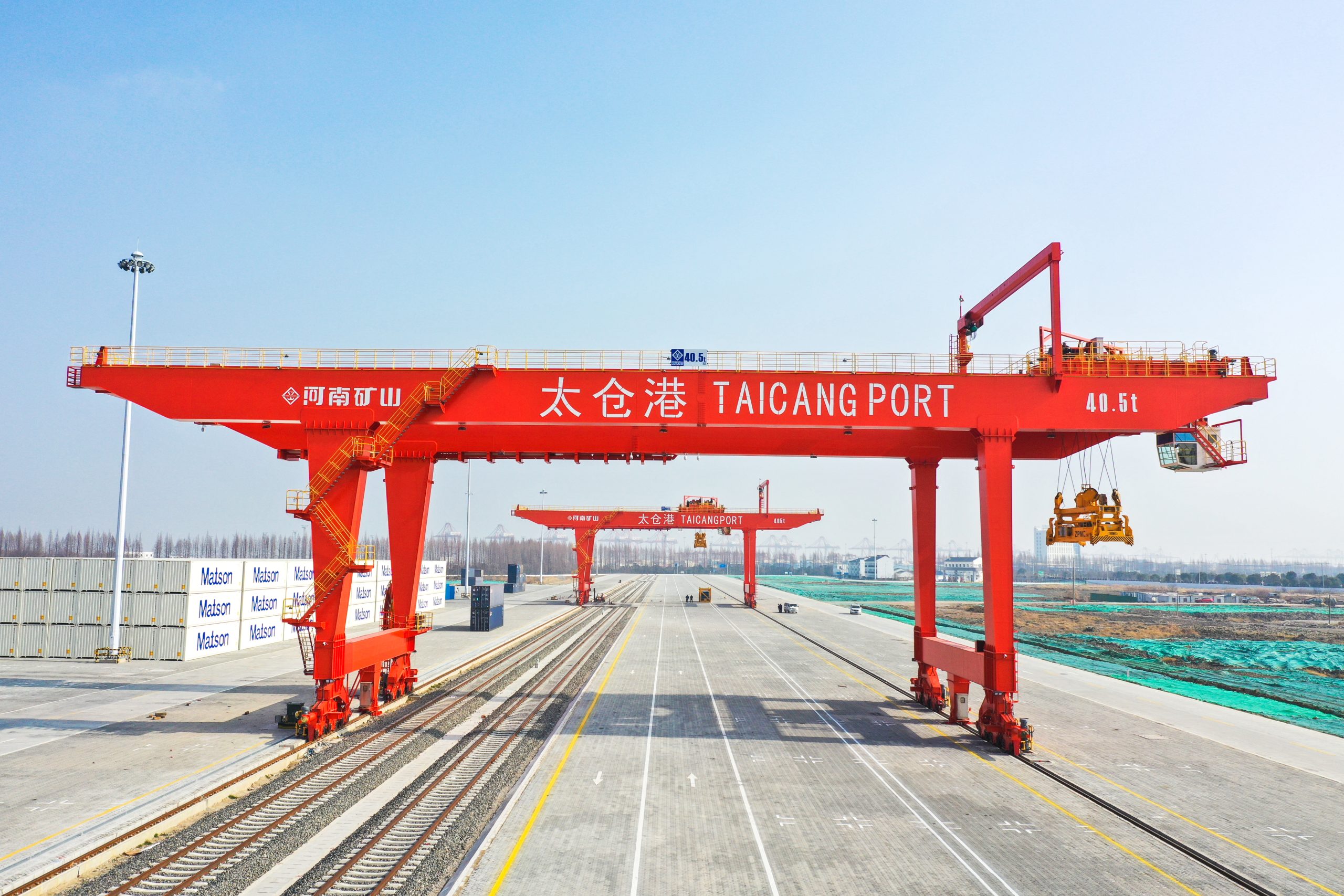
The first technical appendix should describe how containers enter, move through and leave the yard. State whether the block serves a marine terminal, inland port, railway terminal, empty-container depot or industrial logistics hub. Identify the interfaces with ship-to-shore cranes, terminal tractors, external trucks, rail wagons, reach stackers, straddle carriers and warehouse systems.
Choose an RTG When Mobility Has Operational Value
An RTG can move without fixed runway rails and may transfer between blocks when the route and steering arrangement permit. The specification must define block-change frequency, loaded and unloaded travel routes, turning space, pavement slopes and transitions, tire/axle loading, steering modes, lane crossing controls and parking location. Power options should be evaluated with the yard layout and operating cycle.
Choose an RMG When the Yard Layout Is Stable
An RMG follows a fixed rail path and is well suited to stable container blocks, railway transfer areas and repeatable automated movements. The specification must coordinate the rail gauge, rail section, foundation, end stops, storm restraints, cable supply, block length, cantilevers and crane-to-crane operating zones.
Use the RTG vs RMG container yard guide and the STS vs RTG vs RMG role and cost guide before freezing the crane architecture.
2. Specify Capacity, Geometry, Duty and Motion Performance
Do not write only “40 t RTG” or “RMG stacking one-over-five.” The supplier needs the rated load reference, spreader weight, container range, stacking geometry, clearance envelope and full load cycle. State whether capacity is required under the spreader, at a hook/beam interface or in a special handling mode. If twin lifting, offset loads, overheight frames or non-container loads are required, identify them separately.
| Parameter | Buyer-Supplied Basis | Supplier Response Required | Common Specification Error |
|---|---|---|---|
| Rated capacity | Maximum container mass, spreader/attachment basis and special loads. | Rated load at each operating mode and complete suspended-load calculation. | Unclear whether capacity includes or excludes spreader tare. |
| Span/clear width | Rows, lane widths, rail tracks, clearances and coordinate references. | Rail/wheel center reference, clear opening and overall width. | Using nominal row count without a dimensioned cross-section. |
| Stacking/lift height | Required operating stack, passage clearance and container height range. | Maximum spreader height, clear lift and operating clearances. | Stating tiers without clearance above the top container. |
| Cantilevers/approach | Truck, rail, transfer or maintenance interface outside the legs. | Usable outreach, end approach, trolley limits and interference envelope. | Quoting structural cantilever length instead of usable spreader reach. |
| Duty/classification | Moves/hour, hours/day, days/year, load distribution and planned life. | Selected crane/mechanism duty and design load spectrum. | Requesting a class without the operating data behind it. |
| Speeds | Required loaded/empty cycle and operating distances. | Hoist, trolley and gantry speeds; loaded/empty values; acceleration and control range. | Listing maximum speed without cycle assumptions or acceleration. |
| Simultaneous motion | Permitted operating combinations and safety restrictions. | Available combinations, derating, interlocks and cycle effect. | Calculating productivity as if every motion can overlap fully. |
Define a Reference Cycle
Create at least one loaded production cycle and one representative empty return cycle. State the start/end coordinates, hoist height, trolley distance, gantry distance, container weight, positioning tolerance, dwell time, spreader engagement/release, communication delays and permitted simultaneous motions. The cycle test should use the same assumptions used for the guaranteed throughput.
Define Availability Carefully
If availability is guaranteed, specify the measurement period, scheduled maintenance treatment, excluded external causes, standby condition, failure start/end definition, data source and remedy. A percentage without these rules cannot be compared or enforced consistently.
3. Specify the Structure, Mechanisms and Container Spreader
The specification should describe functional requirements and interfaces while allowing the manufacturer to propose a suitable engineered arrangement. Avoid prescribing component brands unless compatibility or fleet standardization requires them; instead state duty, environment, performance, protection, diagnostics, maintainability and acceptance criteria.
Structure and Access
- Gantry/bridge arrangement, trolley type, cantilevers and stiffness basis.
- Platforms, stairs, ladders, guardrails, fall protection and rescue access.
- Maintenance zones and removal routes for motors, brakes, wheels, ropes and spreader.
- Lifting points, jacking points, tie-downs, transport segmentation and erection interfaces.
- Coating system, surface preparation and repair procedure for the site environment.
Hoist and Trolley
- Reeving arrangement, rope/drum/sheave design, equalization and inspection access.
- Brakes, holding strategy, overspeed/overload protection and controlled lowering.
- Drive arrangement, speed control, feedback, anti-sway and positioning requirements.
- Trolley wheel/rail system, buffers, end stops and maintenance lifting points.
- Condition-monitoring points and fault history required for maintenance.
RMG Travel System
- Wheel arrangement, wheel loads, rail compatibility and allowable rail geometry.
- Anti-skew control, travel synchronization, rail sweep/guards and end protection.
- Service/emergency braking, buffers, storm restraints and parking procedure.
- Cable reel/conductor arrangement and cable trench or connection interfaces.
- Crane-to-crane operating zones and anti-collision where multiple cranes share a block.
RTG Travel and Steering
- Tire size/type, axle loads, inflation/monitoring and replacement access.
- Steering modes, turning radius, block transfer, wheel alignment and guidance.
- Travel braking, parking, slope/crossfall limits and obstacle protection.
- Pavement joints, drainage channels, route transitions and allowable surface variation.
- Cable, diesel, hybrid or battery interfaces during travel and block change.
Write a Separate Spreader Specification
Define container lengths, single/twin modes, rated load, telescoping range, twistlock arrangement, landing/alignment devices, flippers/guides, skew/trim/list functions where required, electrical/hydraulic interface, status indication and fault recovery. State the permitted engagement sequence and interlocks that prevent lifting before the spreader is correctly landed and locked.
Clarify whether the spreader is supplied with the crane, provided by another party or owner-furnished. The crane supplier must receive the final spreader mass, center of gravity, electrical data, interface drawing and dynamic information before design freeze.
4. Define Power, Energy and Environmental Conditions
The power system changes operating cost, yard infrastructure, block mobility, emissions, noise, maintenance and automation readiness. Provide the available supply voltage/frequency, connection point, permitted demand, power-quality requirements, cable route and responsibility for transformers, switchgear, cable trenches, charging/fueling and backup power.
| Power Topic | Specification Requirement | Supplier Data Required |
|---|---|---|
| Grid-electric supply | Supply characteristics, connection, cable/conductor route, grounding and outage behavior. | Connected load, maximum demand, harmonics/power factor basis and cable-reel/conductor data. |
| Diesel/generator system | Fuel quality, emissions/noise limits, refueling concept and fire-risk interfaces. | Fuel consumption basis, generator sizing, maintenance access and tank capacity. |
| Hybrid/battery option | Operating cycle, charging opportunity, utility capacity and environmental limits. | Energy storage capacity, charging time/interface, expected operating profile, monitoring and replacement strategy. |
| Regeneration/energy metric | Reference cycle, loads, ambient conditions and measurement boundary. | Expected consumption and test method under the stated reference cycle. |
| Emergency/backup power | Required safe state, emergency lowering/recovery, controls and communication retention. | Supported functions, duration assumptions, changeover and test procedure. |
Environmental Design Data
Provide operating and non-operating temperature range, humidity, rainfall, snow/ice where applicable, dust, salt/marine exposure, corrosion category, solar radiation, lightning, seismic data, altitude and any hazardous substances. State required enclosure/heater/cooling arrangements, low-temperature materials and coating life or inspection basis where these items matter.
Operating and Parking Wind
Do not copy one universal wind value. Define the project wind basis, measuring reference, warning and shutdown logic, travel-to-parking procedure, rail clamps/anchors or RTG parking provisions, responsibility during storms and time required to secure the crane. Require the supplier to show operating, travel, out-of-service and erection wind assumptions separately.
The automated RMG project for a severe-cold railway container yard illustrates why climate, automation and yard architecture must be specified together.
5. Define Controls, Safety, Automation and Civil Interfaces
The control specification should describe how a move is commanded, authorized, monitored, completed and recovered after a fault. For remote or automated cranes, create an interface-control document covering the terminal operating system, equipment-control system, positioning systems, cameras, OCR/container identification, truck/rail interfaces, network and cybersecurity responsibilities.

| Control / Safety Area | Items to Define | Acceptance Evidence |
|---|---|---|
| Operating stations | Cabin, radio, remote desk, automatic mode, local maintenance controls and authority transfer. | Functional test of each mode and controlled transfer between modes. |
| Container/spreader status | Landed/locked/unlocked states, load confirmation, telescoping status and release permissives. | Normal and fault-sequence demonstrations using representative containers. |
| Motion protection | Overload, limits, overspeed, brakes, slack-rope protection where applicable, anti-sway and travel zones. | Cause-and-effect test and recorded setpoints. |
| Collision/obstacle protection | Crane-to-crane, gantry route, truck lane, rail interface, stack profile and maintenance-zone hazards. | Zone maps, test targets/scenarios, alarms and stopping behavior. |
| Positioning and automation | Coordinate system, reference points, accuracy/repeatability, degraded mode and position validation. | Measured tests at representative block locations and operating conditions. |
| Terminal-system interface | Command/status data, message sequence, time synchronization, ownership, unavailable-system behavior and logs. | Interface simulation, integrated site test and traceable event records. |
| Diagnostics/recovery | Alarm hierarchy, event history, remote support, manual recovery, safe access and backup control. | Fault-injection scenarios, recovery procedure and operator training. |
| Cybersecurity/network | Network architecture, remote access, accounts, backups, patching, logging and responsibility boundaries. | Approved architecture, account matrix, backup/restore test and handover records. |
Civil and Yard Infrastructure Interfaces
For an RMG, require maximum/minimum wheel loads, horizontal forces, buffer/end-stop loads, rail data, fastening, tolerances, storm-anchor loads, cable-trench interfaces and foundation requirements. For an RTG, require maximum tire/axle loads, contact pressures, steering/turning envelope, allowable slope/crossfall, surface tolerances, drainage/joint limits and parking/maintenance slab requirements.
Show lighting towers, reefer racks, fences, buildings, rails, roads, drains, cable trenches and other cranes on one coordinated yard drawing. Assign responsibility for civil design, survey, utilities, final alignment and correction of nonconforming infrastructure.
6. Write Measurable Performance Guarantees and Acceptance Tests
Every guaranteed value should include its operating conditions, test method, measurement instrument/data source, allowable tolerance, repeat count, exclusions and remedy. Factory tests verify equipment before shipment; site tests verify the complete crane, yard interface, power and controls after installation.
| Test / Guarantee | Define Before Contract | Acceptance Record |
|---|---|---|
| Design/document review | Drawing/calculation list, review stages, response time, document language/format and approval authority. | Approved drawings, schedules and resolved-comment register. |
| Factory acceptance | Assembly extent, controls simulation, spreader, alarms/interlocks, inspection hold points and witness responsibility. | FAT report, punch list and release for shipment. |
| No-load/functional site test | Motion ranges, speeds, limits, brakes, controls, communications, alarms and operating modes. | Calibrated measurements and signed function checklist. |
| Load test | Test loads/containers, provider, rigging/spreader, sequence, safety plan and governing requirements. | Signed load-test results and corrective actions. |
| Reference cycle/productivity | Coordinates, load, motions, dwell, container/spreader handling, operating mode and external-system response. | Time-stamped cycle data and calculated result. |
| Automation/integration | Normal, degraded and fault scenarios; terminal-system simulator/data; positioning and recovery tests. | Scenario results, event logs and accepted open-item list. |
| Reliability/availability | Demonstration period, operating volume, exclusions, scheduled maintenance and failure-counting rules. | Agreed operational data and failure/maintenance log. |
| Handover | As-built documents, source/configuration backups where contracted, spares, tools, training and warranty conditions. | Handover certificate and controlled document index. |
7. Container Yard Crane RFQ Checklist
Issue these items with the technical specification so bidders price the same operating requirement.
Use the crane quotation information checklist and crane installation planning checklist to define the commercial and site packages around the technical specification.
8. Require a Clause-by-Clause Compliance and Deviation Schedule
Ask every bidder to respond to each numbered clause with “Comply,” “Comply with clarification” or “Deviation.” General statements such as “according to manufacturer standard” should not replace a technical response. Any deviation should identify the affected clause, proposed alternative, technical/commercial effect and price or schedule impact.
| Bid Schedule | Required Supplier Entry | Buyer Evaluation |
|---|---|---|
| Technical compliance | Clause reference, compliance status and exact offered value/configuration. | Identify technical gaps before commercial ranking. |
| Guaranteed parameters | Capacity, geometry, speeds, duty, reference cycle, availability, energy or other contracted guarantees. | Confirm conditions and test method are identical. |
| Interface schedule | Buyer/supplier responsibility for civil, power, spreader, controls, TOS/ECS, network and site data. | Find scope gaps and duplicated responsibility. |
| Supply boundary | Included equipment, spares, tools, documents, software/licenses, installation, testing and training. | Normalize total project cost. |
| Schedule | Design freeze, document approvals, manufacturing, FAT, shipment, installation, SAT and handover milestones. | Check buyer dependencies and credible critical path. |
| Lifecycle support | Maintenance plan, recommended spares, support response, training, warranty and upgrade path. | Compare downtime and long-term support risk. |
Apply the line-by-line crane quotation comparison method to technical, commercial and lifecycle scope. The same approach is valid for container yard cranes even when the product configuration is different.
9. Frequently Asked Questions
Should buyers specify an RTG or RMG first?
Yes, after studying the yard operating concept. Select RTG when block mobility and flexible routing have value; select RMG when the layout is stable and fixed rail-guided, grid-powered or highly repeatable operation is preferred.
Is container capacity stated above or below the spreader?
The specification must state the reference explicitly. Container capacity under the spreader and total suspended load including spreader tare are different values, and both should be shown in the supplier's load schedule.
How should stacking height be specified?
State container heights, required operating stack and clearance above the top container. Include the highest spreader position, transfer lane clearance and any overheight or special-container handling.
Can crane speed alone guarantee moves per hour?
No. Productivity also depends on acceleration, travel distance, simultaneous motions, spreader engagement, container positioning, truck/rail readiness, communication delays and operating restrictions. Use a defined reference cycle.
What civil data is required for an RMG?
Provide rail gauge/section, block length, alignment/elevation, foundation concept, end stops, cable route, storm-anchor interfaces and site survey. The supplier should provide wheel loads and other project reactions for the responsible civil designer.
What pavement data is required for an RTG?
Provide route widths, turning areas, slopes/crossfall, pavement/slab capacity, joints, drains, surface condition and block-transfer crossings. The supplier should provide tire/axle loads and travel-envelope requirements.
What does “automated RMG” need to include?
Define command and status interfaces, positioning, container identification, spreader status, cameras, obstacle/collision protection, operating zones, fault recovery, remote supervision, network/cybersecurity and integrated acceptance scenarios.
Which documents should be delivered at handover?
Require approved and as-built drawings, manuals, parts lists, electrical/control documentation, software/configuration backups where contracted, test records, certificates, maintenance schedules, training records, warranty documents and resolved-punch-list status.
Final Recommendation
Freeze the Yard Operating Concept
Define container mix, block layout, traffic, stacking, throughput, interfaces and future expansion before selecting RTG or RMG.
Convert Operations Into Measurable Crane Parameters
State rated load reference, spreader modes, geometry, duty, speeds, simultaneous motions, power, environment and maintenance access.
Control Every Project Interface
Assign responsibility for civil works, power, spreader, terminal systems, network, installation, tests, training and handover.
Make Guarantees Testable
Define performance conditions, instruments/data, test sequence, exclusions, acceptance limits and remedy before contract award.
Request an RTG or RMG Technical Proposal
Send Henan Mine Crane your container schedule, yard plan and cross-section, target stacking pattern, moves per hour, operating cycle, power supply, climate data, civil information, automation interfaces, destination and project schedule. Our technical sales and engineering teams can review the specification and prepare a project-specific container yard crane configuration and quotation.
Request a Container Yard Crane Quote
Review Crane Lifecycle Services