How Crane Duty Class Affects Price, Reliability, and Service Life
Crane duty class describes how intensively a crane and its mechanisms are expected to work over the design horizon. It is determined from operating cycles, load spectrum, motion usage and the governing classification standard—not from lifting capacity alone. Selecting the correct duty class may increase initial investment compared with a lightly designed crane, but it protects availability, component life and lifecycle value. Selecting too low a class creates premature wear and downtime; selecting too high a class can add avoidable equipment and building cost.
The Direct Answer: Duty Class Changes More Than the Crane Price
Two cranes can have the same 20-ton capacity and span yet require very different structures, hoists, motors, brakes, gearboxes, wheels, controls and maintenance provisions. A crane used for occasional maintenance lifts is not exposed to the same accumulated fatigue and thermal loading as a crane completing hundreds of production movements per shift. The quotation must therefore match both the maximum load and the expected operating intensity.
| Selection Result | Initial Price | Reliability Effect | Service-Life Effect | Buyer Decision |
|---|---|---|---|---|
| Duty class too low | Often looks cheapest at tender stage. | Higher risk of overheating, excessive wear, nuisance trips and unplanned stops. | Fatigue and component-life assumptions may be consumed earlier than planned. | Reject unless the bidder demonstrates that the declared duty basis covers the real process. |
| Duty class correctly matched | Price reflects the required structural and mechanism performance. | Components operate within their intended mechanical and thermal duty when correctly used and maintained. | Provides a defensible basis for the required design horizon and maintenance plan. | Use as the commercial and technical comparison baseline. |
| Duty class unnecessarily high | May add equipment weight, drive size, wheel loads and civil cost. | Extra rating does not correct poor installation, maintenance, operation or environmental protection. | May provide unused design margin without a proportional lifecycle return. | Ask for the engineering reason and compare total installed value. |
1. What Does Crane Duty Class Actually Measure?
Duty classification converts the expected use of the crane into an engineering design basis. Depending on the named standard, classification considers the number of working cycles or operating time, the distribution of light and heavy loads, average motion or travel, and the required design life. The complete crane and each mechanism may have different classifications because the hoist, trolley and bridge do not always operate for the same duration or under the same load.
Estimate Total Working Cycles Before Requesting Quotes
A useful planning estimate is: cycles per hour × operating hours per day × working days per year × design years. Define the start and end of one working cycle so all bidders use the same count. If the crane makes several hoists within one material-handling sequence, state whether these are separate cycles under the governing standard. Provide normal, peak and future production scenarios rather than a single optimistic average.
| Buyer Input | Data to Provide | Why It Changes Classification |
|---|---|---|
| Cycle definition | Pickup, hoist, travel, placement, return and any intermediate handling steps. | Prevents one bidder counting a full production sequence while another counts each lift. |
| Operating schedule | Shifts/day, hours/shift, days/year, planned years and seasonal peaks. | Establishes the utilization and total design exposure. |
| Load bands | Percentage of cycles at 0–25%, 26–50%, 51–75% and 76–100% of rated load, or the bands required by the selected standard. | Frequent near-capacity lifts create a heavier spectrum than frequent light loads. |
| Motion demand | Lifts/hour, starts/hour, average lift, trolley distance, bridge distance and speed profile. | Determines mechanism operating time, thermal duty and wear exposure. |
| Future growth | Expected throughput increase, heavier products, automation or an added shift. | Avoids consuming the intended duty basis earlier than the investment plan. |
For a complete input list covering capacity, span, lift, speeds, controls and environment as well as duty, use the overhead crane selection guide and the crane quotation information checklist.
2. How Duty Class Changes the Purchase Price
A higher duty requirement does not create one fixed price percentage. Its cost effect depends on capacity, span, speeds, crane type, mechanism arrangement, environment, redundancy and component brands. It can influence the complete crane from steelwork to controls. Buyers should therefore compare the declared technical design—not simply request “one class higher” and assume every component changes in the same way.
| Cost Area | Possible Higher-Duty Design Change | Buyer Verification | Hidden Project Effect |
|---|---|---|---|
| Bridge and trolley structure | Fatigue-resistant detailing, revised plate thickness, local reinforcement and controlled weld categories. | Structural standard, duty basis, material, weld quality plan and fatigue-critical details. | Higher self-weight and maximum wheel loads can affect runway and foundations. |
| Hoisting machinery | Different motor thermal rating, brake arrangement, reducer, drum, sheaves, rope reeving, bearings or cooling. | Mechanism group, starts/hour, ED rating where applicable, brake duty, reeving and calculated rope life basis. | Larger machinery can change headroom, hook approach and maintenance access. |
| Trolley and bridge travel | Drive quantity, motor/reducer size, braking, wheel and bearing selection, anti-skew or inverter control. | Travel distance, starts, acceleration, wheel loads, rail interface and allowable skew. | Runway alignment quality becomes more important as cycle accumulation increases. |
| Electrical and controls | Higher-rated contactors, drives, resistors, cooling, cable systems, condition monitoring or control redundancy. | Enclosure, temperature, switching frequency, drive duty, fault response and spare capacity. | Power supply, harmonics, cooling and network integration may add site scope. |
| Safety and redundancy | Additional brakes, monitoring, emergency functions or redundant load paths when required by the application and standard. | Risk assessment, critical lifting function, failure response and inspection/test requirements. | More components require maintenance, proof testing, spares and trained personnel. |
| Maintenance access | Platforms, walkways, lifting points, removable panels, service lighting and component removal routes. | Confirm included access, isolation and major-component replacement method. | Upfront access cost can reduce recurring service time and production stoppage. |
When reviewing price, separate crane supply, runway or support steel, electrical feed, transport, erection, testing, training, spares and lifecycle service. A higher-duty crane may increase self-weight or wheel loads, so the lowest equipment price can still produce a higher installed project cost if civil assumptions are missing. Use the line-by-line crane quotation comparison guide to normalize scope before awarding the order.
3. How Duty Class Affects Crane Reliability
Reliability improves when the crane’s structural, mechanical, electrical and thermal capacities match the actual work. A correctly classified mechanism has appropriate margins for its intended load spectrum and operating duration. An underclassified mechanism repeatedly operates outside the assumptions used for selection, accelerating heat generation, wear and fatigue.
Motor and Brake Heating
More starts, reversals and long running periods can exceed the intended thermal duty, causing trips, brake fade, rapid lining wear or insulation deterioration.
Gearbox and Bearing Wear
A heavier-than-declared load spectrum and repeated shock loads increase tooth and bearing stress, lubricant temperature and wear progression.
Rope, Drum and Sheave Wear
Frequent lifting and poor reeving geometry consume bending cycles faster, especially when ropes, sheaves, fleet angle or lubrication do not match the service.
Wheel and Rail Damage
High travel cycles amplify the consequences of misalignment, skewing, unequal drive performance and runway defects, leading to flange wear and bearing damage.
Electrical Switching Wear
Contactors, resistors, collectors, festoons, cables and drive components must tolerate the real switching frequency and travel exposure.
Structural Fatigue
Repeated stress ranges can initiate cracking at fatigue-sensitive details even when individual lifts remain below rated capacity.

4. How Duty Class Affects Service Life and Lifecycle Cost
Crane service life is not one universal number. The bridge structure, hoisting machinery, brakes, ropes, wheels, bearings, contactors and consumables have different life calculations and replacement criteria. Duty class establishes a design-use basis; it does not guarantee that every component will last for the full structural design horizon without replacement.
| Life Category | What Duty Influences | What Buyers Should Require |
|---|---|---|
| Structural fatigue design | Number and magnitude of stress cycles in girders, end carriages, trolley frame and fatigue-sensitive connections. | Declared standard, classification, design cycles, load spectrum and fatigue design basis. |
| Calculated component life | Gear, bearing, wheel, rope, drum and sheave loading plus operating cycles or hours. | Selection basis, inspection limits, lubrication plan and forecast replacement intervals. |
| Wear-item life | Frequency of braking, rope bending, collector travel, switching and friction exposure. | Inspection criteria, adjustment limits, recommended spares and safe replacement method. |
| Environmental life | Duty compounds the effects of heat, dust, corrosion, cold, moisture and contamination. | Protection system, temperature range, enclosure ratings, coatings, seals and maintenance method. |
| Economic service life | Downtime, labor, spare parts, energy, inspection and modernization needs over the ownership period. | Lifecycle service plan, local spare strategy, maintainability and upgrade path. |
Evaluate the Cost of Required Availability
Lifecycle cost should include purchase, freight, erection, civil work, power, inspections, preventive maintenance, consumables, planned component replacement, energy, downtime and modernization. For a production-critical crane, one hour of lost output can be more expensive than the price difference between two technical configurations. For a standby maintenance crane used only a few times each month, the same upgrade may deliver little economic benefit.
The correct duty class is therefore the lowest classification that fully and demonstrably covers the real load spectrum, cycles, process risk and design horizon under the named standard—with appropriate margin for known production growth. It is not automatically the highest available class.
After commissioning, compare actual starts, loads and operating hours with the design assumptions. If production changes, review the duty basis before adding shifts, heavier attachments or faster cycle targets. The overhead crane preventive maintenance checklist can help convert the design basis into an asset-specific service program.
5. How to Compare Duty Class in Crane Quotations
A quotation stating only “heavy duty,” “A6” or “FEM class” is incomplete. The buyer must be able to trace the proposed classification back to the same operating data and standard used by every bidder. Otherwise, apparently similar quotations may contain different design lives, mechanism ratings and price scopes.
| Quotation Line | Minimum Required Declaration | Red Flag |
|---|---|---|
| Governing classification | Full standard name, edition and any owner or national supplements. | Class label shown without a standard or edition. |
| Complete crane classification | Crane/appliance group and the cycle/load-spectrum assumptions used. | Capacity treated as proof of duty class. |
| Mechanism classifications | Separate group for main hoist, auxiliary hoist, trolley travel and bridge travel. | One overall label copied to every mechanism without calculations. |
| Operating assumptions | Cycles, hours, starts, load bands, travel distances, speeds and design years. | “Normal workshop use” with no quantified schedule. |
| Component selections | Motors, brakes, reducers, drums, ropes, wheels, bearings, drives and controls matched to declared duty. | Brand names listed without model, rating or selection basis. |
| Weights and reactions | Crane self-weight, trolley weight, maximum/minimum wheel loads and horizontal forces. | Civil designer receives only rated lifting capacity. |
| Lifecycle support | Inspection access, maintenance intervals, recommended spares, training and service response. | No maintenance plan for a high-utilization production crane. |
| Exceptions and deviations | Written list of every departure from the RFQ and applicable standard. | Silence interpreted as compliance. |
Normalize all quotations to one data sheet before comparing price. If a bidder recommends a different class, require a written calculation basis and a list of resulting changes to crane weight, wheel loads, headroom, power demand, maintenance and delivery scope. Commercial comparison should begin only after these differences are visible.
6. A1–A3, A4–A6, and A7–A8: An Indicative Buyer View
The grouping below is a practical screening view used across the Henan Mine Crane product catalog. It is not a substitute for classification under the governing project standard. The final class must be calculated from quantified usage and confirmed in the technical agreement.
| Indicative Group | Typical Procurement Profile | Common Buyer Risk | Engineering Focus |
|---|---|---|---|
| Light: A1–A3 | Occasional maintenance, infrequent assembly, standby or low-cycle handling with a generally light load spectrum. | Buying light duty for a process that later becomes daily production work. | Confirm future shifts, peak loads and whether the crane is truly non-production. |
| Medium: A4–A6 | Regular manufacturing, fabrication, warehouse or process support with repeated daily cycles and a mixed load spectrum. | Using one average tonnage while ignoring near-capacity lifts, starts/hour or long travel. | Quantify each mechanism’s duty, throughput target and required availability. |
| Severe: A7–A8 | Continuous or highly repetitive production, frequent heavy loads, harsh processes, automation or mission-critical handling. | Assuming the class label alone covers heat protection, redundancy, monitoring and maintenance access. | Integrate duty with environment, risk, controls, redundancy, inspection and spare strategy. |
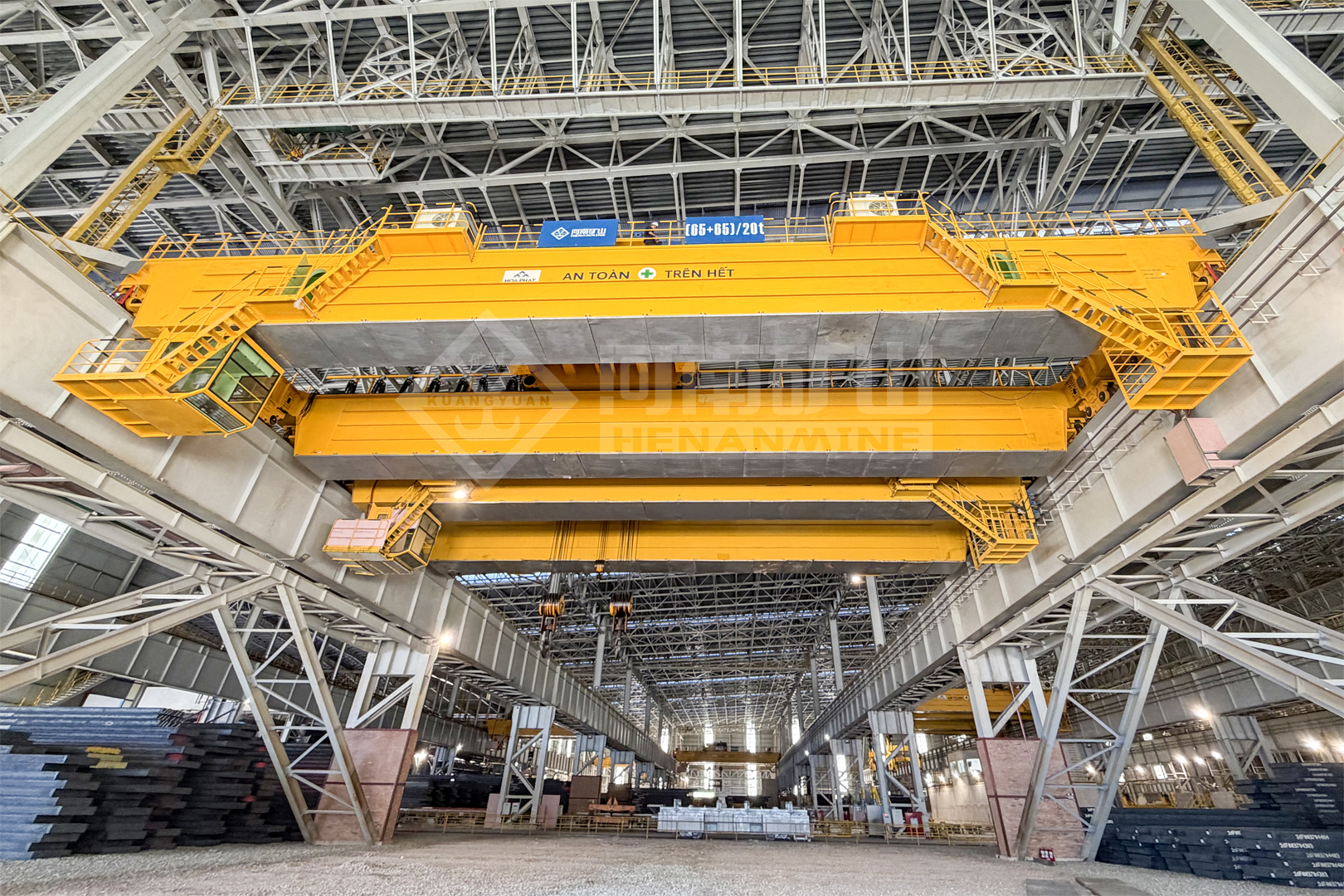
For hot and production-critical applications, review the steel mill overhead crane buying guide before selecting the duty class, heat-protection package and redundancy strategy.
7. Which Operating Conditions Usually Require More Duty?
Application names are useful starting points, not final classifications. A maintenance crane can be high duty if it serves a continuous shutdown program, while a large-capacity crane may be light duty if used only for occasional equipment overhaul. Classify the actual motion and load history.
Maintenance and Assembly
Often lower utilization, but heavy individual components, precision positioning and future production use must still be declared.
Fabrication and Manufacturing
Repeated daily lifting, mixed loads and long bridge travel commonly make mechanism-level data essential.
Steel, Foundry and Bulk Handling
Frequent heavy loads, impacts, grabs or magnets, heat and dust can increase structural, mechanism and environmental demands together.
Automated Production
High repeatability and unattended cycles can accumulate use faster than manual operation, requiring accurate throughput and availability targets.
Warehouse and Coil Logistics
Long travel, high starts, attachment weight and frequent positioning can make travel duty as important as hoisting duty.
Powerhouse Overhaul
Very high capacity may coexist with low cycle count, but load control, precision, dual-hook operation and critical-lift requirements remain project-specific.
8. Crane Duty Class RFQ Checklist
Send the same quantified duty sheet to every crane supplier. If data is not yet available, ask the supplier to show each assumption clearly rather than hiding it behind a class label.
Attach layout drawings and a process description whenever possible. For a structured tender document, use the complete overhead crane RFQ checklist.
9. Frequently Asked Questions
Is crane duty class the same as lifting capacity?
No. Capacity is the maximum rated suspended load for the defined configuration. Duty class describes cumulative use through cycles, load spectrum and mechanism operation. A low-capacity production crane can require a higher duty class than a large maintenance crane.
Does a higher duty class always mean a more reliable crane?
Only when it is part of a correctly integrated design. Reliability still depends on environment, component quality, controls, runway alignment, installation, maintenance and operation. An unnecessarily high class can increase cost without addressing the actual failure risks.
Can A1–A8, FEM and CMAA classes be converted directly?
Do not use an undocumented direct conversion. The systems can classify different scopes and use different definitions. The supplier should identify the governing standard, show the operating assumptions and provide a project-specific engineering comparison when more than one system appears in the contract.
Can the hoist, trolley and bridge have different mechanism groups?
Yes. Their operating time, starts, travel and load exposure can differ. Require the classification and selection basis for every main mechanism instead of accepting only one complete-crane label.
How much more does a higher-duty crane cost?
There is no universal percentage. The difference depends on which structures, mechanisms, motors, brakes, wheels, controls, protection systems and access provisions must change. Request an itemized technical comparison together with self-weight, wheel-load and power impacts.
What if the exact number of cycles is unknown?
Use production throughput, material flow, shift schedule and motion distances to build normal, peak and growth scenarios. State all assumptions in the RFQ and require the selected class to cover the agreed worst credible operating case.
Can duty class be changed after the crane is installed?
A changed duty requires engineering review of the structure, hoist, brakes, drives, wheels, controls, runway and accumulated service history. A new label or larger motor alone does not rerate the complete crane.
Final Recommendation
Classify the Work Before Selecting the Crane
Define cycles, load spectrum, motion distances, starts, design years, environment and future production before requesting final quotations.
Require a Named Standard and Mechanism-Level Data
Ask for the governing standard and edition, the complete-crane class and separate groups for every hoist, trolley and bridge mechanism.
Compare Total Installed and Lifecycle Cost
Include crane weight, wheel loads, power, civil scope, maintenance access, spares, planned replacement and downtime—not only equipment price.
Monitor Actual Use After Commissioning
Track starts, loads, hours and defects so changed production does not silently exceed the design basis.
Request a Duty-Class-Matched Crane Proposal
Send Henan Mine Crane your capacity, span, lifting height, operating cycles, load spectrum, speeds, travel distances, shifts, design years, environment, building data and required availability. Our technical sales and engineering teams can recommend the crane configuration, complete-crane classification, mechanism groups and lifecycle service scope for your project.