KS1 Low-Headroom Wire Rope Electric Hoist
For low buildings, retrofit cranes and restricted-headroom lifting systems where gaining usable hook height is more important than using a standard hoist layout.

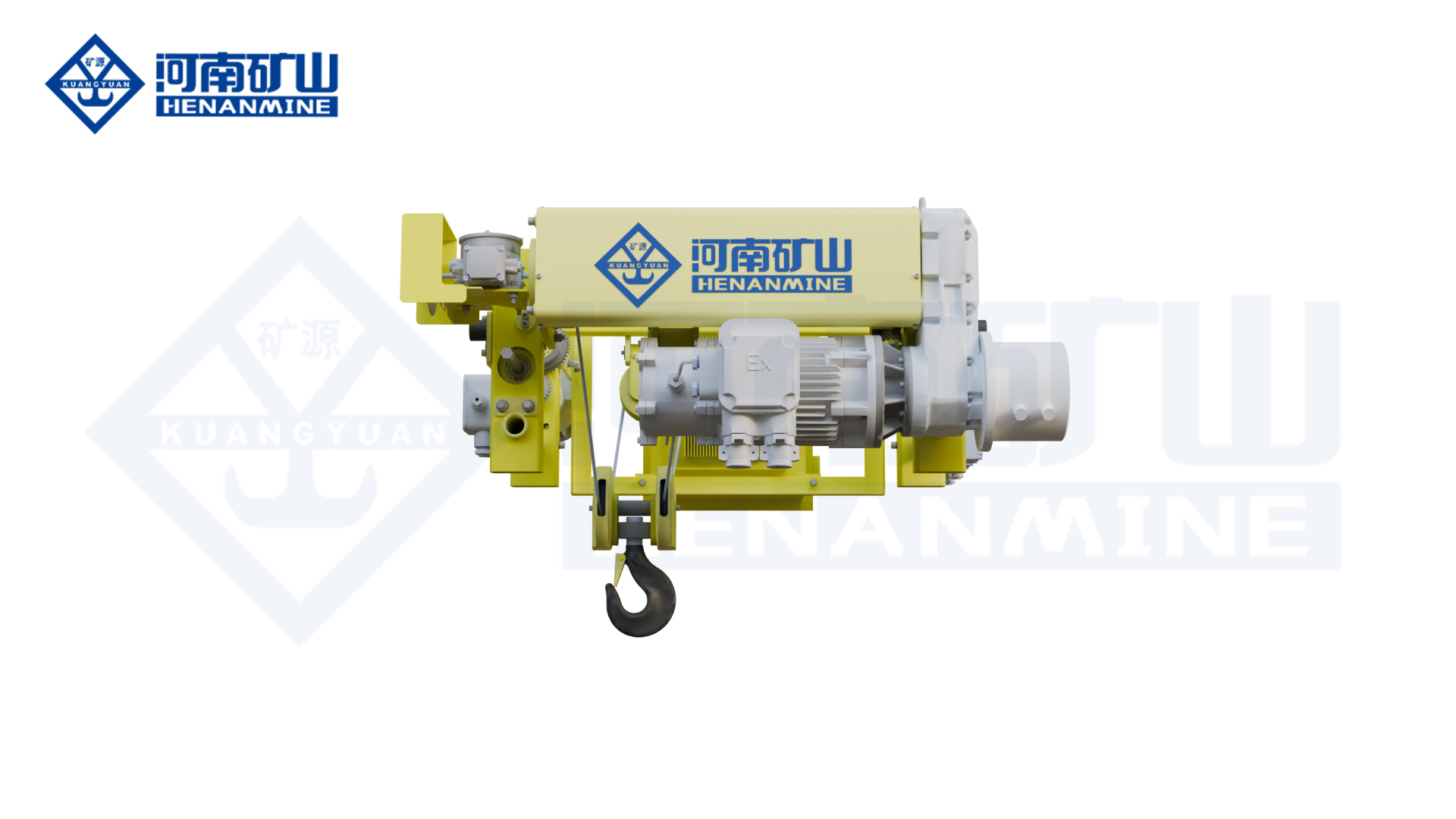
Henan Mine Crane ks1 low-headroom electric hoist source image showing the primary hoist structure and lifting arrangement.
Wire rope electric hoists are compact lifting units used for lifting, pulling and loading / unloading. The source states that they can be installed independently on I-beams or integrated with single-girder, double-girder, jib and gantry cranes.
For procurement, KS1 is primarily a headroom decision. The buyer should measure the building / crane geometry first and then confirm whether the source-stated 30%–50% overall-height reduction creates enough additional usable hook height for the process.
Quick Specifications
| Product Model |
KS1 |
| Type-Test Product Name |
Wire Rope Electric Hoist |
| Lifting Capacity |
Configured according to project requirements |
| Lifting Height |
Configured according to project requirements |
| Hoisting Speed |
Project-specific |
| Travel Speed |
Project-specific if trolley-mounted |
| Working Duty |
Selected from operating frequency and load spectrum |
| Mounting / Host Interface |
Configured to the I-beam, trolley rail or crane |
| Headroom / Hook Approach |
Project-specific |
| Control Method |
Project-specific |
| Power Supply |
According to site electrical conditions |
Best For: For low buildings, retrofit cranes and restricted-headroom lifting systems where gaining usable hook height is more important than using a standard hoist layout.
Request A KS1 Low-Headroom Electric Hoist Quote
Product Overview
Type-test specification: KS1.
Type-test product name: Wire Rope Electric Hoist.
Source describes the general wire rope hoist as compact, lightweight and easy to operate.
Can be installed on I-beams or integrated with single-girder, double-girder, jib or gantry cranes.
Any capacity, lifting height, speed, duty, headroom, synchronization tolerance, energy-saving percentage or other guaranteed value that is not explicitly published for the exact product should be defined by the project and written into the technical agreement.
Why Choose KS1 Low-Headroom Electric Hoist?
More Usable Hook Height
The source-stated 30%–50% overall-height reduction can recover vertical lifting space in restricted buildings.
Reduced Upper Hook Limit
The optimized motor / drum arrangement is intended to bring the hook closer to the supporting structure.
Retrofit Value
Can be relevant when the building roof cannot be raised but the process needs more effective lifting height.
Multiple Installation Forms
Source confirms suspended and trolley-mounted configurations.
Compact Wire Rope Hoist
Retains a wire rope hoist format while targeting restricted headroom.
Product Images

Official source image associated with the KS1 low-headroom wire rope electric hoist and its compact installation arrangement.
|

Official source image associated with the KS1 low-headroom wire rope electric hoist and its compact installation arrangement.
|
Main Hoist Components
| Hoisting Motor |
Selected from capacity, duty, speed and product configuration. |
| Reducer / Transmission |
Transfers motor torque to the drum; source-specific features are listed below where confirmed. |
| Wire Rope Drum & Reeving |
Configured from lifting height, rope system and hook approach. |
| Hook Block |
Selected from rated load and lifting application. |
| Travel Trolley / Mounting System |
Configured to I-beam, trolley rail or host crane where travel is required. |
| Brake & Safety Devices |
Configured from the hoist duty and project safety requirements. |
| Electrical & Control System |
Configured according to the product's source-supported functions and project requirements. |
Technical Parameters
| Model |
KS1 |
| Product Type |
KS1 Low-Headroom Wire Rope Electric Hoist |
| Type-Test Product Name |
Wire Rope Electric Hoist |
| Capacity |
Project-specific |
| Lifting Height |
Project-specific |
| Hoisting Speed |
Project-specific |
| Travel Speed |
Project-specific if trolley-mounted |
| Working Duty |
Project-specific |
| Headroom / Hook Approach |
Project-specific |
| Beam / Rail Interface |
Project-specific |
| Control Method |
Project-specific |
| Power Supply |
According to site electrical conditions |
| Environment |
According to indoor/outdoor, dust, temperature, humidity and corrosion conditions |
Source-Confirmed Features & Buyer-Defined Options
Source-confirmed product facts:
- Type-test specification: KS1.
- Type-test product name: Wire Rope Electric Hoist.
- Source describes the general wire rope hoist as compact, lightweight and easy to operate.
- Can be installed on I-beams or integrated with single-girder, double-girder, jib or gantry cranes.
- Optimized motor and drum layout reduces overall hoist height.
- Source states overall hoist height can be reduced by 30%–50%.
- Source states the upper-limit hook distance is minimized.
- Modular design supports suspended and trolley-mounted installation forms.
Buyer-defined items:
- Maximum suspended load
- Lifting height and headroom
- Hoisting / travel speed
- Operating frequency / duty
- I-beam / rail / crane interface
- Control method
- Power supply
- Environmental conditions
- Installation / commissioning scope
Application Scenarios
| Low Workshops |
Where roof height limits standard hoist geometry. |
| Retrofit Overhead Cranes |
Improving hook height without rebuilding the entire building. |
| Production Lines |
Lifting over tall machines where headroom is limited. |
| Monorail / Trolley Systems |
Suspended or trolley-mounted installation according to project layout. |
How to Select the Right KS1 Low-Headroom Electric Hoist
1. Measure Available Headroom
Provide beam bottom elevation, roof obstruction and required top hook position.
2. Define Required Hook Height
State the highest load pickup / placement position and lowest pickup level.
3. Provide Beam / Rail Geometry
Flange width, rail dimensions and trolley interface affect installation.
4. Confirm the 30%–50% Claim Against the Project
The source publishes a product-family reduction; the final dimensional saving must be checked against the selected capacity and arrangement.
5. Choose Suspended or Trolley-Mounted Form
Select from the actual crane / monorail structure.
6. Define Maintenance Clearance
Low-headroom layouts should still provide safe access for rope, brake, motor and reducer service.
Low-Headroom Data Buyers Should Measure
| Available Headroom |
Measure from the supporting beam / rail to the roof or upper obstruction. |
| Required Hook Height |
Define the actual process requirement, not only the building height. |
| Source Height Reduction |
30%–50% source-stated for the optimized hoist layout. |
| Upper Hook Approach |
Source states this is minimized; final dimension is project-specific. |
| Installation Form |
Suspended or trolley-mounted, source-confirmed. |
Safety & Control: What Buyers Should Confirm
• Rated capacity and overload-protection requirement
• Upper / lower lifting limits
• Brake and emergency-stop requirements
• Travel limits if trolley-mounted
• Control station / pendant / remote requirements
• Host-crane interlocks if the hoist is integrated into a crane
• Any two-trolley coordination / synchronization protection where applicable
• Factory and site functional / load acceptance tests
Installation & Maintenance
Before manufacture, confirm beam / rail dimensions, available headroom, hook approach, lifting height, travel length, power supply, control location and maintenance access. If the hoist is part of a crane, provide the crane arrangement drawing so the trolley and electrical interfaces can be checked.
Maintenance should follow the final supplied manual and actual duty. Routine attention normally includes wire rope, hook, drum, brake, motor, reducer, trolley wheels where fitted, limits, fasteners and electrical connections. Product-specific modular or IoT functions should be included in the maintenance plan where supplied.
What Information Do We Need for a Quote?
| 1 |
Maximum lifting capacity |
| 2 |
Lifting height |
| 3 |
Available headroom |
| 4 |
Required upper hook position |
| 5 |
Beam / rail dimensions |
| 6 |
Suspended or trolley-mounted installation |
| 7 |
Required hoisting / travel speed |
| 8 |
Working duty |
| 9 |
Control method |
| 10 |
Power supply |
| 11 |
Building cross-section / crane drawing |
| 12 |
Destination / installation scope |
Frequently Asked Questions
Can capacity and lifting height be customized?
Yes. The source pages do not publish one universal capacity or lifting-height range for these exact products, so selection should be project-specific.
Can the hoist run on an I-beam?
The source states that wire rope electric hoists can be installed independently on I-beams or integrated with several crane types.
What is the most important dimension for a low building?
Available headroom and required upper hook position. For severe restrictions, compare the KS1 low-headroom arrangement.
How should source percentage claims be used?
Treat them as source product data. If a reduction or saving is contract-critical, define the comparison baseline and acceptance method.
What information improves quotation accuracy most?
Capacity, lifting height, duty, beam / rail dimensions, headroom, speed, control, power supply and a crane / building drawing.
Related Wire Rope Electric Hoists
KS New-Type Wire Rope Electric Hoist
KSS New-Type Double-Trolley Wire Rope Electric Hoist
CD Wire Rope Electric Hoist
Request A KS1 Low-Headroom Electric Hoist Quote
Send your lifting capacity, lifting height, headroom, beam / rail dimensions, operating duty, required speeds, control method and power supply. Henan Mine Crane can then review the hoist and host-crane interface and prepare a project-specific configuration and quotation.
Request A Quote