Wind Turbine Manufacturing Overhead Crane Solution

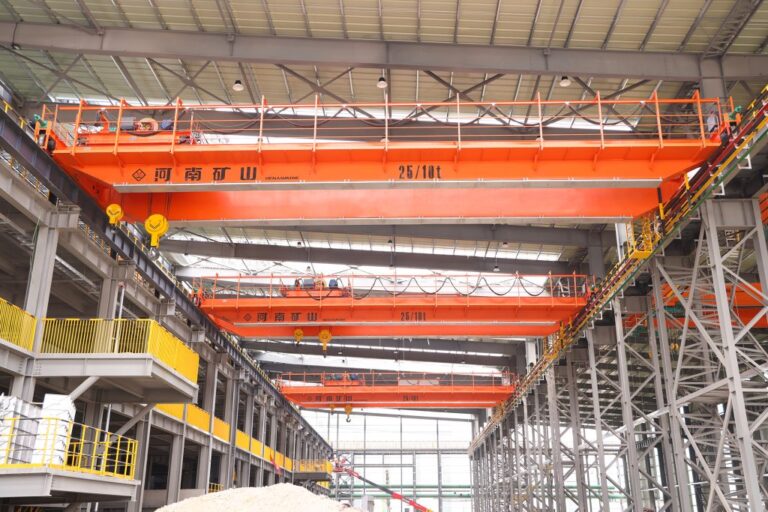
Multiple Henan Mine Crane bridge cranes with different capacities installed across a wind-turbine production workshop.
Wind-turbine factories need a crane fleet that can move nacelles, hubs, generators, frames and assembly tooling through different production bays. Capacity may vary by workstation, but buyers still want consistent controls, energy performance, installation efficiency and maintenance standards across the plant.
Henan Mine Crane supplied a batch of large-span, high-precision and low-energy cranes for Windey wind-turbine mainframe production and assembly. The source project states that the cranes use full variable-frequency control, modular design, quick aviation-plug wiring and one-time lifting installation without onsite welding.
Project Background
A wind-turbine manufacturing line combines heavy assembly positions with lower-capacity tooling and maintenance lifts. Using one capacity everywhere increases cost, while using unrelated crane designs increases spare-parts and maintenance complexity.
A coordinated crane fleet can therefore standardize control philosophy and components while selecting the correct capacity, span, hooks and lifting attachments for each production bay.
Customer Challenges
- Different production stations require different crane capacities and hook arrangements.
- Large workshop spans demand stable bridge structures and accurate travel.
- Heavy components need smooth motion to protect assemblies and fixtures.
- Factory construction schedules benefit from faster crane installation with less onsite fabrication.
- Energy consumption becomes important when several cranes operate across a large production base.
- Long-term maintenance is easier when controls and components are standardized across the fleet.
Henan Mine Crane Solution
The referenced cranes use full variable-frequency control for smoother operation and reduced energy consumption. Modular design simplifies manufacturing and installation interfaces.
Quick aviation-plug wiring reduces field connection work, while the source project describes one-time lifting installation without welding throughout the onsite installation process.
The crane series is designed around lightweight, generalized and lower-maintenance concepts. For a new wind-turbine plant, the fleet can be standardized while capacities and lifting arrangements remain specific to each production task.
| Recommended Crane |
Large-Span Double-Girder Wind Turbine Manufacturing Crane |
| Typical Applications |
Wind turbine mainframe production, nacelle assembly, component handling and maintenance |
| Control |
Full variable-frequency control |
| Installation Concept |
Modular structure + quick aviation-plug wiring + reduced onsite welding |
| Fleet Strategy |
Standardized controls with application-specific capacities and hook arrangements |

Large 200/50t bridge crane serving heavy wind-turbine component assembly and production handling.
|

Heavy bridge girder being lifted into position during wind-turbine factory crane installation.
|

Medium-capacity overhead crane serving component assembly in a wind-power manufacturing bay.
|

75/20t bridge crane used for wind-turbine components, tooling and assembly support.
|
Key Technical Features
Full VFD Control
Variable-frequency drives provide smooth movement and reduce energy use during repeated production handling.
Large-Span Precision Travel
Crane structure and travel systems can be engineered for wide wind-turbine production bays.
Modular Design
Modular construction simplifies assembly, replacement and project coordination.
Quick Electrical Connections
Aviation-plug wiring reduces field electrical connection time.
Reduced Site Welding
The referenced project uses a one-time lifting installation concept without onsite welding, helping shorten installation work.
Fleet Standardization
Common control and maintenance concepts can be applied across cranes with different capacities.
Application Scenarios
| Wind Turbine Mainframe Production |
Handling major frames and assemblies through production stations. |
| Nacelle Assembly Lines |
Controlled movement of generators, gearboxes and nacelle components. |
| Wind Power Component Workshops |
Crane fleets serving multiple capacities and tasks. |
| Factory Expansion Projects |
Modular crane installation coordinated with new production-bay construction. |
Why Choose Henan Mine Crane
- Henan Mine Crane can plan the whole crane fleet instead of sizing each machine in isolation.
- Full VFD control, modular design and standardized components can reduce operating and maintenance complexity.
- Capacities and hook arrangements can still be customized for each wind-turbine production station.
- Installation planning can account for building completion, lifting access, wiring interfaces and future plant expansion.
Frequently Asked Questions
What crane capacities are used in a wind-turbine manufacturing plant?
Capacity varies by workstation. The referenced project images show several capacities, while a new project should be sized from the heaviest component and each production bay's actual lifting tasks.
Why use full VFD control for wind-turbine cranes?
VFD control provides smoother acceleration and low-speed positioning while also reducing unnecessary energy use during frequent production movement.
Can a wind-factory crane be installed with less site welding?
Yes. The referenced project uses modular construction, aviation-plug connections and a one-time lifting installation concept without onsite welding.
What should be provided for a crane fleet quotation?
Send a crane schedule for each bay: capacity, span, lifting height, runway length, load type, duty, speeds, hook arrangement, power supply and required delivery sequence.
Request A Water Resources & Power Crane Solution
Send your load data, plant or workshop drawings, lifting sequence, operating environment and control requirements. Henan Mine Crane engineers will review the application and prepare a project-specific crane proposal.
Request A Quote
|
View Overhead Cranes