BKS New-Type Explosion-Proof Wire Rope Electric Hoist
For buyers who need a compact wire rope electric hoist for a classified hazardous area and want the explosion-protection specification, lifting duty and host-crane interface defined before quotation.

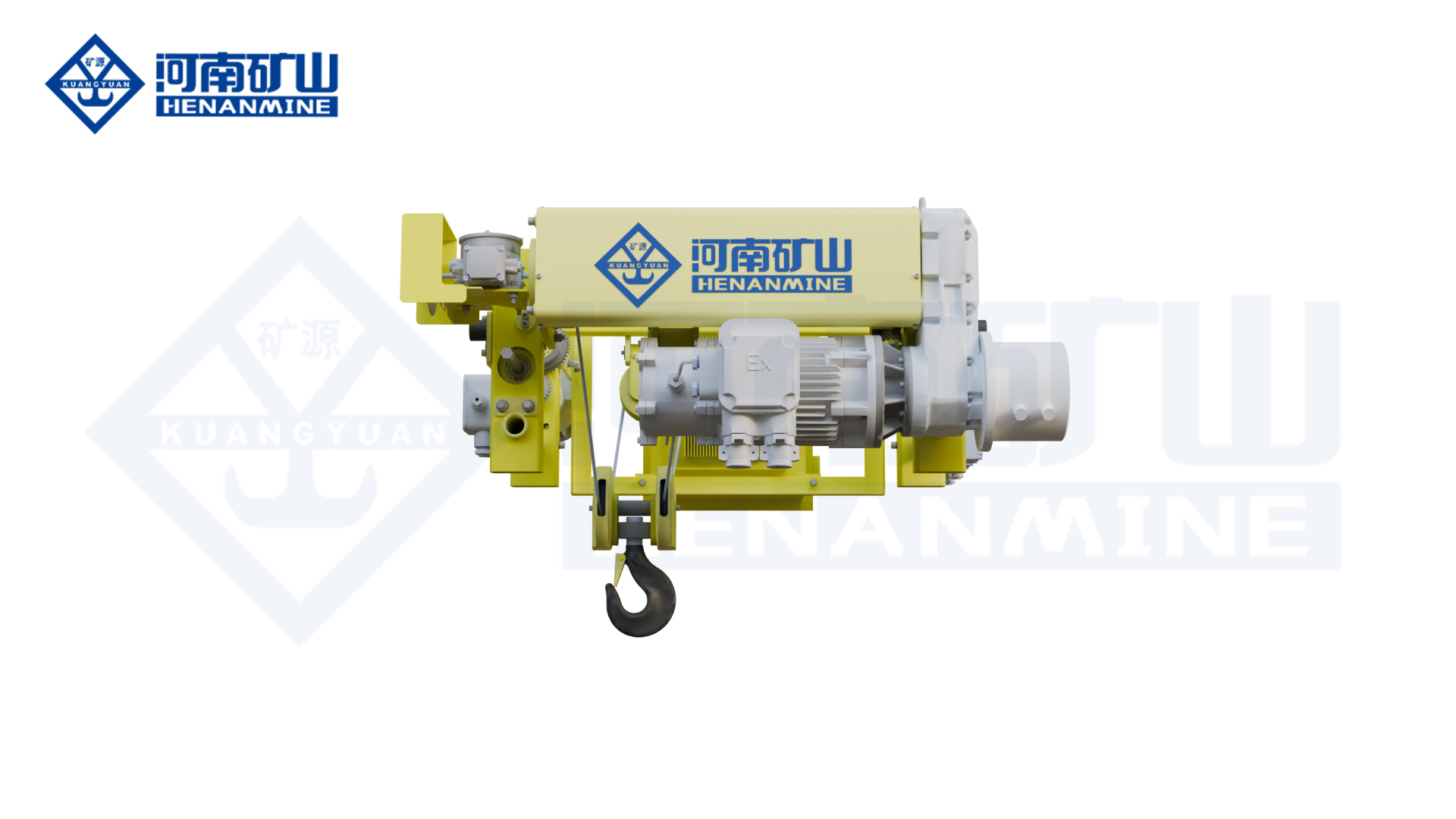
Henan Mine Crane BKS explosion-proof wire rope electric hoist source image showing the hoist body and flameproof product configuration.
The BKS new-type explosion-proof wire rope electric hoist is designed as a flameproof lifting device for hazardous industrial environments. The source states that key components use special explosion-proof construction to isolate internal electrical sparks or high temperatures from an external explosive mixture.
For procurement, the most important question is not only the lifting capacity. The buyer should first provide the approved hazardous-area classification, hazardous gas or vapor information, required explosion-protection marking or certification standard, lifting capacity, lifting height, duty cycle, available headroom and the crane or monorail interface.
Quick Specifications
| Product Model |
BKS |
| Type-Test Product Name |
Explosion-Proof Wire Rope Electric Hoist |
| Explosion-Protection Form |
Flameproof construction (source-stated) |
| Source Certification Statement |
Source states the product passed testing by the relevant machinery-industry explosion-proof electrical product quality supervision and inspection center and obtained an explosion-proof certificate |
| Lifting Capacity |
Configured according to project requirements |
| Lifting Height |
Configured according to project requirements |
| Working Duty |
Configured according to operating frequency and load spectrum |
| Mounting / Running Interface |
Configured to the host crane, trolley beam or monorail |
| Control |
Configured according to the approved hazardous-area and project requirements |
| Power Supply |
According to site electrical conditions |
Best For: Hazardous industrial lifting applications where a wire rope hoist is required and the final flameproof configuration must be matched to an approved project hazardous-area specification.
Request A BKS Explosion-Proof Hoist Quote
Product Overview
The source describes the BKS as an explosion-proof wire rope electric hoist designed according to Chinese explosion-proof requirements. Its explosion-protection concept is stated as flameproof construction, with mechanical and electrical explosion-protection measures used to support lifting operation in explosive-atmosphere environments.
The source also confirms a hard-tooth-surface reducer with an integrated gearbox housing. Source-stated gear-tooth hardness is at least 60 HRC and source-stated transmission efficiency is above 95%. The source further claims service life of the reducer is 2–3 times that of a traditional soft-tooth-surface reducer.
The source does not publish one universal capacity, lifting height, hoisting speed, explosion-protection grade, gas group, temperature class, duty class or mounting dimension. These items must be selected from the actual project and should not be copied from another explosion-proof hoist.
Why Choose the BKS Explosion-Proof Wire Rope Hoist?
Flameproof Product Concept
The source explicitly identifies a flameproof explosion-protection form for the hoist.
Mechanical + Electrical Explosion-Protection Measures
The source states that both mechanical key components and the electrical system use explosion-protection measures.
Hard-Tooth Gear Reducer
Source-stated tooth hardness is at least 60 HRC, with an integrated gearbox housing.
High Transmission Efficiency
The source states transmission efficiency above 95%.
Source-Claimed Longer Reducer Life
The source states 2–3 times the life of a traditional soft-tooth-surface reducer; project maintenance conditions should still be defined separately.
Lightweight / Low-Noise Design
The source highlights lightweight construction, low noise, lower energy consumption and smooth operation.
Load-Adaptive Speed Concept
The source states heavy-load slow operation and light-load fast operation.
Product Images

Official source image associated with the BKS new-type explosion-proof wire rope electric hoist and its compact lifting mechanism.
|

Official source image associated with the BKS new-type explosion-proof wire rope electric hoist and its compact lifting mechanism.
|
Main Hoist Components
| Wire Rope Hoisting Mechanism |
Provides vertical lifting; final capacity, reeving and lifting height are project-specific. |
| Flameproof Motor / Electrical System |
Configured to the approved hazardous-area requirement and source-described flameproof concept. |
| Hard-Tooth Reducer |
Source-confirmed hard-tooth gears with integrated housing. |
| Drum / Rope System |
Configured from lifting height, reeving, hook approach and duty. |
| Hook Block |
Selected from rated load and project lifting requirements. |
| Travel Trolley / Mounting Interface |
Configured to the host crane or monorail if travel is required. |
| Control / Protection System |
Configured according to explosion-protection requirements, operating mode and project safety specification. |
Technical Parameters
| Model |
BKS |
| Product Type |
New-Type Explosion-Proof Wire Rope Electric Hoist |
| Type-Test Product Name |
Explosion-Proof Wire Rope Electric Hoist |
| Explosion-Protection Form |
Flameproof construction, source-stated |
| Capacity |
Project-specific |
| Lifting Height |
Project-specific |
| Hoisting Speed |
Project-specific |
| Travel Speed |
Project-specific if trolley travel is required |
| Working Duty |
Project-specific |
| Headroom / Hook Approach |
Project-specific |
| Beam / Rail Interface |
Project-specific |
| Explosion-Protection Marking |
Project-specific; must match the approved hazardous-area specification |
| Control Method |
Project-specific |
| Power Supply |
According to site electrical conditions |
| Environmental Conditions |
According to temperature, humidity, corrosion and hazardous medium |
Source-Confirmed Features & Buyer-Defined Options
Source-confirmed product facts:
- Type-test specification: BKS.
- Type-test product name: Explosion-Proof Wire Rope Electric Hoist.
- Product is designed according to Chinese explosion-proof requirements.
- Explosion-protection form is stated as flameproof.
- Key mechanical components and the electrical system use explosion-protection measures.
- Source states the product passed testing by the relevant machinery-industry explosion-proof electrical product quality supervision and inspection center and obtained an explosion-proof certificate.
- Reducer uses hard-tooth-surface gears with source-stated tooth hardness >=60 HRC.
- Integrated gearbox housing is source-confirmed.
- Source-stated reducer transmission efficiency is >95%.
- Source claims reducer service life is 2–3 times that of a traditional soft-tooth-surface reducer.
- Source highlights lightweight design, low noise, low energy consumption and smooth operation.
- Source states heavy-load slow operation and light-load fast operation.
Buyer-defined items:
- Approved hazardous-area classification
- Hazardous gas / vapor / other explosive mixture information
- Required explosion-protection marking / certificate standard
- Maximum lifting capacity including rigging
- Lifting height
- Operating frequency / duty cycle
- Required hoisting and travel speeds
- Host crane / monorail beam dimensions
- Available headroom and hook approach
- Control method
- Power supply
- Ambient temperature, humidity and corrosion conditions
- Installation / commissioning / certification-document scope
Application Scenarios
| Chemical / Process Plants |
Lifting in classified production or maintenance areas where the approved hazardous-area specification requires explosion-protected equipment. |
| Petrochemical Facilities |
Equipment handling where a flameproof hoist is required by the plant classification. |
| Hazardous Manufacturing Areas |
Maintenance and production lifting in areas with an approved explosion-risk classification. |
| Explosion-Proof Overhead Cranes |
BKS can be configured as the lifting mechanism when the complete crane design requires an explosion-proof wire rope hoist. |
| Explosion-Proof Gantry / Monorail Systems |
Project-specific use where the runway and control system are designed for the same hazardous-area requirements. |
How to Select the Right BKS Explosion-Proof Hoist
1. Start with the Hazardous-Area Specification
Provide the approved plant or project classification before selecting any explosion-protected electrical equipment.
2. Define the Hazardous Medium
Identify the gas, vapor or other explosive mixture and the required project marking / group / temperature requirement where applicable.
3. Define the Full Suspended Load
Include the lifted item plus hooks, spreaders, fixtures or permanent rigging.
4. Define Lifting Height and Headroom
Provide beam elevation, lowest pickup point, highest hook position and any low-headroom constraint.
5. Define Operating Duty
Provide lifts per hour, hours per shift and the approximate load spectrum.
6. Define Travel / Beam Interface
If the hoist travels on a beam, provide beam type, flange / rail data and required travel length.
7. Define Control and Documentation
Specify control method, emergency-stop logic, required certificates and buyer acceptance documents.
Explosion-Proof Specification: What Buyers Must Confirm
| Hazardous-Area Classification |
Use the approved plant / project classification. |
| Hazardous Medium |
Identify the explosive gas, vapor or mixture relevant to the installation. |
| Required Marking |
Provide the required explosion-protection marking, group and temperature requirement where applicable. |
| Applicable Standard |
State the national, plant or project standard controlling procurement and acceptance. |
| Installation Boundary |
Clarify whether only the hoist or the full crane / monorail system is inside the classified area. |
| Electrical Accessories |
Pendant, remote receiver, junction boxes, cable system and other accessories must match the project requirement. |
| Documentation |
Define certificates, inspection records and acceptance documentation required with the hoist. |
Procurement note: The source confirms a flameproof BKS explosion-proof wire rope hoist, but it does not publish one universal explosion-protection grade or marking. Do not select the hoist by product name alone; match the final configuration to the approved hazardous-area specification.
BKS vs Standard Explosion-Proof Hoist: Buyer Decision
| BKS New-Type Focus |
Source emphasizes hard-tooth reducer design, high transmission efficiency, lightweight structure, lower noise / energy and load-adaptive speed behavior. |
| Standard Selection Basis |
Both new-type and conventional explosion-proof hoists must first satisfy the same project hazardous-area and lifting requirements. |
| When BKS Adds Value |
Consider BKS when the buyer values the source-described reducer efficiency, compact / lightweight design and heavy-load slow / light-load fast operating concept. |
| What Still Must Be Engineered |
Capacity, lift height, headroom, duty, speeds, beam interface and explosion-protection marking remain project-specific. |
Safety & Control: What Buyers Should Confirm
• Rated capacity and overload-protection requirement
• Upper / lower lifting limits
• Brake and emergency-stop requirements
• Explosion-protection marking / component certification required by the approved hazardous-area specification
• Pendant / remote / control-station explosion-protection requirement
• Travel limits if the hoist includes trolley motion
• Power-isolation and maintenance procedure for the hazardous area
• Factory documentation and site acceptance tests
Installation & Maintenance
Before manufacture and installation, confirm the host crane or monorail beam dimensions, available headroom, hook approach, lifting height, power supply, travel length and the hazardous-area boundary. The complete electrical accessory list should be checked against the same explosion-protection requirement as the hoist.
Maintenance should follow the final supplied manual and the plant's hazardous-area procedures. Routine inspection should cover wire rope, hook, drum, reducer, brakes, travel wheels if fitted, limits, electrical enclosures, cable connections and all explosion-protected components. Any repair affecting explosion protection should follow the approved maintenance and certification procedure.
What Information Do We Need for a Quote?
| 1 |
Approved hazardous-area classification |
| 2 |
Hazardous gas / vapor / mixture information |
| 3 |
Required explosion-protection marking / standard |
| 4 |
Maximum lifting capacity |
| 5 |
Lifting height |
| 6 |
Required hoisting speed / speed behavior |
| 7 |
Travel speed / travel length if trolley-mounted |
| 8 |
Operating frequency / working duty |
| 9 |
Host beam / rail dimensions |
| 10 |
Available headroom / hook approach |
| 11 |
Control method |
| 12 |
Power supply |
| 13 |
Ambient temperature / humidity / corrosion |
| 14 |
Required certificate / inspection documents |
| 15 |
Destination and installation / commissioning scope |
Frequently Asked Questions
What does BKS refer to?
BKS is the source-listed type-test specification for this new-type explosion-proof wire rope electric hoist.
What is the source-listed product name?
Explosion-Proof Wire Rope Electric Hoist.
What explosion-proof form does the source state?
The source states a flameproof construction concept. It does not publish one universal project explosion-protection marking.
Does the source give a standard lifting capacity or lifting height?
No. Capacity and lifting height are not published as universal values on the source page and should be selected from the project.
What reducer data is source-confirmed?
The source states hard-tooth-surface gears with tooth hardness at least 60 HRC and transmission efficiency above 95%.
What does heavy-load slow / light-load fast mean for procurement?
It is a source-described operating concept. If the exact speeds or transition logic matter contractually, specify them in the technical agreement.
What information is most important for an accurate quotation?
Hazardous-area data, capacity, lifting height, duty, beam / rail interface, headroom, control method, power supply and certification requirements.
Related Lifting Equipment
Explosion-Proof Electric Hoist
Explosion-Proof Overhead Crane
Explosion-Proof Gantry Crane
Request A BKS Explosion-Proof Wire Rope Hoist Quote
Send your hazardous-area specification together with lifting capacity, lifting height, operating duty, beam / rail dimensions, headroom, required control method, power supply and certification requirements. Henan Mine Crane can then review the lifting and explosion-protection requirements together and prepare a project-specific hoist configuration and quotation.
Request A Quote