YZS Four-Girder Casting Overhead Crane
For steel plants requiring a four-girder, four/six-rail, double-trolley casting crane for molten-metal transfer, ladle tilting and auxiliary lifting.

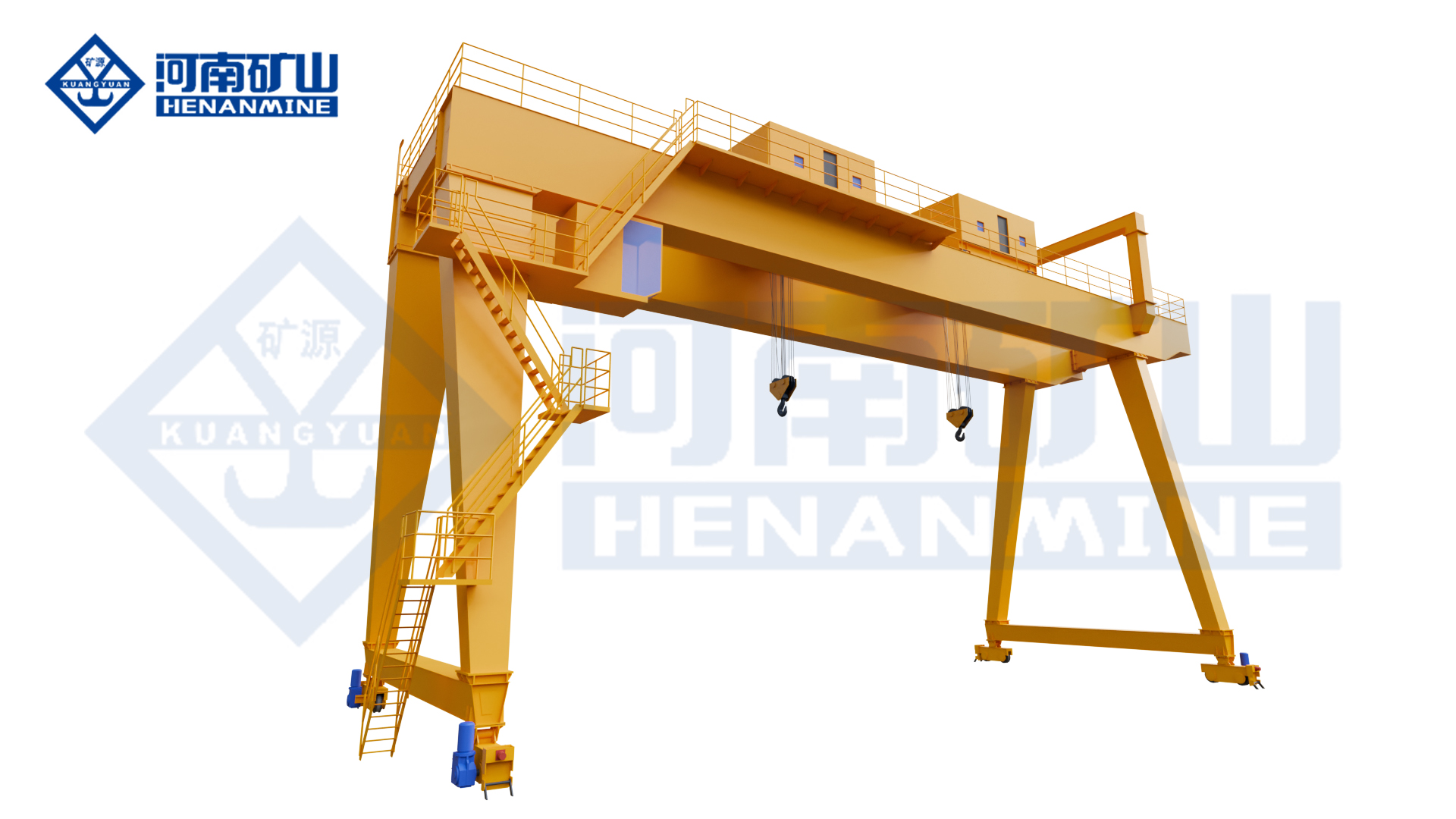
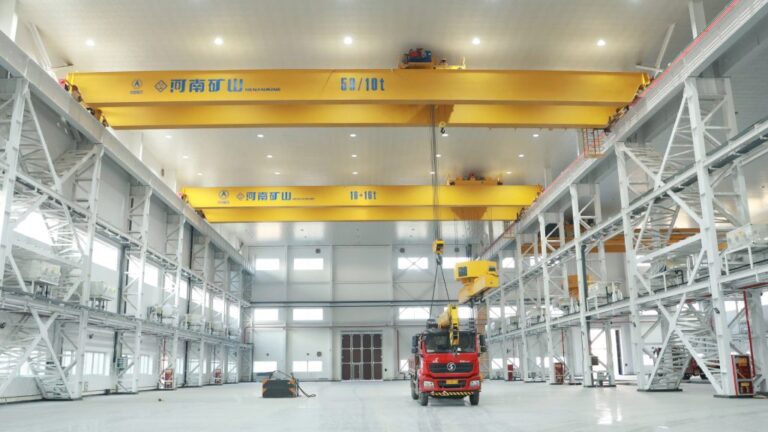
Henan Mine Crane yzs four-girder casting crane showing the main crane structure and metallurgical lifting arrangement.
The YZS four-girder casting crane is a heavy metallurgical bridge crane for molten-metal transfer, pouring and tilting operations. The source specifies a four-girder, four- or six-rail, double-trolley layout.
The main trolley uses a double lifting-point fixed gantry plate-hook device for the molten-metal ladle, while the auxiliary trolley uses a forged hook and runs on separate rails. Buyers should define ladle reactions, tilting sequence, auxiliary lifting duties and production cycles.
Quick Specifications
| Model |
YZS |
| Type-Test Product Name |
Metallurgical Overhead Crane |
| Capacity |
Configured according to project requirements |
| Span |
Configured according to runway center distance |
| Lifting Height |
Configured according to process requirements |
| Working Duty |
Source-defined where stated; otherwise project-specific |
| Heat Protection |
Configured according to actual thermal exposure |
| Control Method |
Configured according to project requirements |
Best For: For steel plants requiring a four-girder, four/six-rail, double-trolley casting crane for molten-metal transfer, ladle tilting and auxiliary lifting.
Request A YZS Four-Girder Casting Crane Quote
Product Overview
Four-girder, four- or six-rail, double-trolley metallurgical crane.
Main trolley uses a double-lifting-point fixed gantry plate-hook lifting device.
Auxiliary trolley uses a forged hook and runs on separate rails.
Any capacity, span, speed, temperature limit, synchronization accuracy or other guaranteed performance value that is not published on the source page should be confirmed from the actual project and written into the technical agreement.
Why Choose YZS Four-Girder Casting Crane?
Heavy Casting Architecture
Four girders and separate trolley rails support demanding metallurgical load paths.
Main + Auxiliary Trolleys
Dedicated main ladle handling and auxiliary hook work can be separated.
Ladle Tilting Capability
Designed for molten-metal transfer and tilting processes.
Two-Stage Hoisting Limit Protection
Source confirms rotary and weight-type upper-limit protection.
PLC/VFD + Safety Monitoring
Supports controlled heavy-duty process operation.
Product Images

Source image associated with the YZS Four-Girder Casting Crane, showing the crane structure, lifting device or metallurgical application.
|

Source image associated with the YZS Four-Girder Casting Crane, showing the crane structure, lifting device or metallurgical application.
|

Source image associated with the YZS Four-Girder Casting Crane, showing the crane structure, lifting device or metallurgical application.
|

Source image associated with the YZS Four-Girder Casting Crane, showing the crane structure, lifting device or metallurgical application.
|

Source image associated with the YZS Four-Girder Casting Crane, showing the crane structure, lifting device or metallurgical application.
|

Source image associated with the YZS Four-Girder Casting Crane, showing the crane structure, lifting device or metallurgical application.
|
Main Crane Components
| Bridge Structure |
Metallurgical bridge structure selected from load, span, duty and thermal conditions. |
| Hoisting / Trolley System |
Configured around the process load and required motion. |
| Load Handling Device |
Project-specific ladle device, clamp, hook or charging-box attachment according to the product. |
| Heat Protection |
Insulation / high-temperature materials selected around radiant heat. |
| Safety & Control |
Configured from source-supported functions and project-specific safety requirements. |
Technical Parameters
| Model |
YZS |
| Product Type |
YZS Four-Girder Casting Overhead Crane |
| Capacity |
Project-specific |
| Span |
Project-specific |
| Lifting Height |
Project-specific |
| Hoisting Speed |
Project-specific |
| Travel Speed |
Project-specific |
| Working Duty |
Project-specific unless source-stated |
| Control Method |
Project-specific |
| Power Supply |
According to site electrical conditions |
| Thermal Environment |
According to ambient and radiant heat |
| Safety / Acceptance |
According to project standard and technical agreement |
Source-Confirmed Features & Buyer-Defined Options
Source-confirmed product facts:
- Four-girder, four- or six-rail, double-trolley metallurgical crane.
- Main trolley uses a double-lifting-point fixed gantry plate-hook lifting device.
- Auxiliary trolley uses a forged hook and runs on separate rails.
- Used for molten-metal transfer, ladle tilting and general auxiliary lifting.
- Source working class A6–A8.
- PLC, HMI and WLK master controller are source-listed.
- Hoisting anti-overtravel uses rotary limit plus weight-type limit for two-stage protection.
- Main/end girders use heat protection.
- Safety monitoring, PLC + VFD communication control and finite-element structural analysis are source-listed.
Buyer-defined items:
- Maximum suspended load
- Span and lifting height
- Operating cycle / duty
- Thermal exposure
- Process attachment geometry
- Control and safety functions
- Testing and commissioning scope
Application Scenarios
| Steelmaking |
Molten-metal ladle transfer. |
| Casting Bays |
Pouring and ladle tilting. |
| Converter / Furnace Areas |
Heavy metallurgical process lifting. |
| Large Foundries |
Main ladle handling plus auxiliary lifting. |
How to Select the Right YZS Four-Girder Casting Crane
1. Define Main-Trolley Load
Include ladle, molten metal and gantry lifting device.
2. Define Auxiliary-Trolley Load
Provide independent auxiliary hook duty.
3. Define Tilting Sequence
State the geometry and required relative trolley/hook movement.
4. Define Rail / Building Loads
Four/six rails create project-specific runway reactions.
5. Define Safety / Monitoring
Specify required limits, safety monitoring and acceptance tests.
Four-Girder Casting Crane RFQ Priorities
| Main / Auxiliary Loads |
Specify each trolley separately. |
| Ladle Tilting |
Define the full tilting sequence and required clearances. |
| Runway Arrangement |
Confirm four- or six-rail system and building reactions. |
| Safety Limits |
Source confirms two-stage upper-limit protection; define all contractual safety functions. |
Safety & Control: What Buyers Should Confirm
• Rated capacity / overload protection
• Primary and emergency braking requirements
• Upper / lower hoisting limits and travel limits
• Heat-resistant electrical and mechanical protection
• Safety monitoring / alarms / records where required
• Operator control position and visibility
• Factory and site acceptance tests
Installation & Maintenance
Before manufacture and installation, confirm runway span, rail / runway-beam condition, elevation, available headroom, process equipment clearances, heat sources, electrical supply and erection access. The metallurgical lifting device and safety interfaces should be frozen before production.
Maintenance should follow the final supplied manual and plant safety procedures. In addition to normal crane mechanisms, metallurgical cranes require attention to heat shields, high-temperature cables, brakes, safety limits, lifting devices and safety-monitoring functions.
What Information Do We Need for a Quote?
| 1 |
Main trolley total load |
| 2 |
Auxiliary trolley load |
| 3 |
Ladle / plate-hook geometry |
| 4 |
Tilting sequence |
| 5 |
Span / lifting height / runway length |
| 6 |
Four- or six-rail arrangement requirements |
| 7 |
A6–A8 duty inputs |
| 8 |
Heat exposure |
| 9 |
Safety monitoring requirements |
| 10 |
Control method |
| 11 |
Workshop layout |
| 12 |
Destination / commissioning |
Frequently Asked Questions
How is crane capacity selected?
Use the complete suspended load, including the ladle, box, clamp, lifting device or other below-the-hook equipment.
Can capacity and span be customized?
Yes. Unless the source page states a fixed range, capacity and span should be engineered from the project.
Why is radiant heat data required?
Metallurgical crane structural, cable, motor and protection design depends on actual thermal exposure.
Can automation be added?
Where the source confirms PLC, VFD or automation capability, the final automation scope should be defined by the buyer's process and acceptance requirements.
What should be written into the technical agreement?
Any performance that matters contractually—duty, speed, heat protection, synchronization, weighing, automation or safety function—should be stated with its acceptance method.
Related Metallurgical Overhead Cranes
YZD Metallurgical Overhead Crane
YB Slab Handling Overhead Crane
YH Quenching Overhead Crane
YZ Double-Girder Casting Overhead Crane
YX Charging Box Metallurgical Overhead Crane
Request A YZS Four-Girder Casting Crane Quote
Send your load, span, lifting height, runway length, workshop drawing, process cycle, temperature conditions and metallurgical safety requirements. Henan Mine Crane engineers will review the application and prepare a project-specific crane configuration and quotation.
Request A Quote | View Overhead Cranes