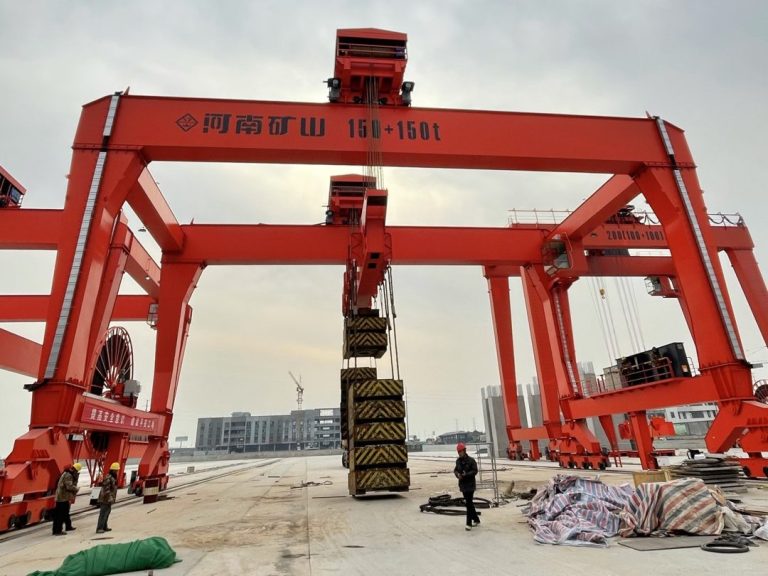
Carbon Block Stacking Crane for Carbon Material Baking Plant

Project overview of the Henan Mine Crane carbon block stacking system operating in a carbon-material baking workshop.
Carbon-material baking plants need a crane that can pick, stack and transfer heavy carbon blocks accurately while operating in a dusty, high-temperature environment. Standard hook cranes are usually inefficient for this process because block geometry, stack density and production throughput require a purpose-built lifting attachment.
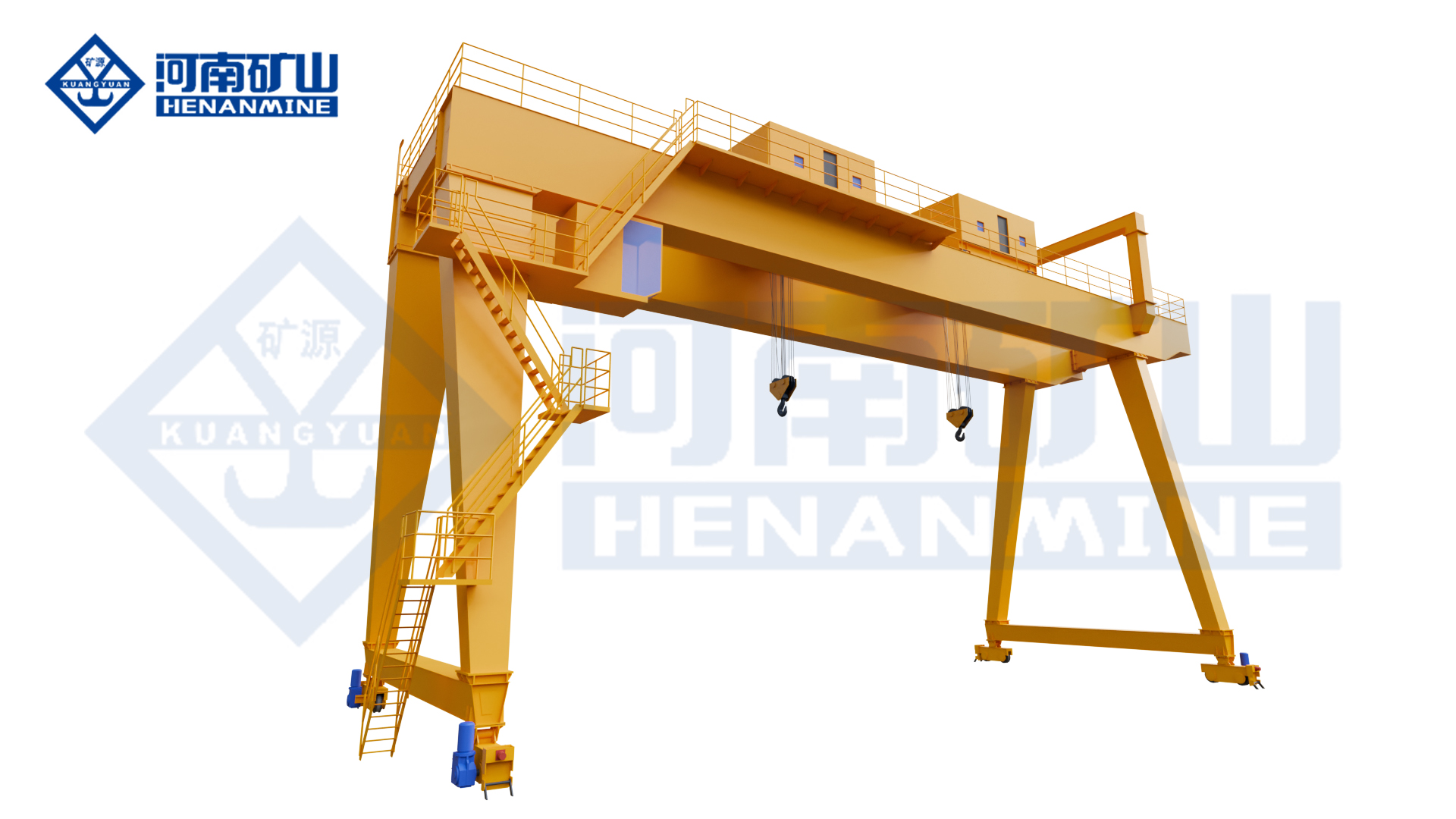
Henan Mine Crane developed a carbon block stacking crane for a new carbon-material baking-furnace project in Shandong. The referenced crane uses a box-type double-girder structure, one trolley and two specialized lifting devices, with variable-frequency drives, rigid guide columns and centralized electrical protection.
Project Background
Carbon blocks must be stacked closely and repeatedly around the baking process. The crane therefore has to combine accurate attachment positioning, stable clamping pressure and smooth bridge, trolley and hoisting movement.
The source project uses a lightweight design to reduce building cost. Its integrated three-in-one variable-frequency drive system supports low-noise, smooth starting and reduced impact on the crane structure and workshop.
The two lifting devices use rigid guide columns, multiple sets of rail-type guide wheels and high-strength wear-resistant guide tracks. Each lifting device can work independently or the two can operate together.
Customer Challenges
- Accurately picking and stacking carbon blocks without repeated manual alignment.
- Maintaining stable lifting-device pressure throughout the handling cycle.
- Allowing two lifting devices to work independently or in synchronized operation.
- Reducing impact loads on the crane runway and workshop structure.
- Protecting electrical equipment in high-dust and high-temperature conditions.
- Providing reliable limit protection, emergency control and safety monitoring for repetitive production duty.
Henan Mine Crane Solution
Henan Mine Crane configured the crane as a box-type double-girder, single-trolley system with two specialized lifting devices. The lighter structural concept reduces unnecessary dead weight while retaining the rigidity required for repetitive carbon-block handling.
The rigid-guide lifting arrangement uses several groups of rail-type guide wheels and wear-resistant guide tracks to control attachment movement. The two lifting devices can be operated separately or together, giving the production line more flexibility for different stacking and transfer tasks.
Bridge travel and hoisting use variable-frequency speed control. The electrical control system is centralized in a dedicated electrical room with an industrial internal-circulation air-conditioning system so the controls are better protected from the dusty, hot process environment.
Safety limits, emergency electrical switches, alarms and safety-monitoring devices are integrated into the crane to support dependable long-term operation.
| Recommended Crane |
Carbon Block Stacking Double-Girder Overhead Crane |
| Crane Structure |
Box-type double girder + single trolley + dual lifting devices |
| Attachment |
Dual rigid-guide carbon-block lifting devices |
| Drive Control |
Variable-frequency travel and hoisting with integrated three-in-one drives |
| Environment |
High-dust and high-temperature carbon-material baking workshop |
| Electrical Protection |
Centralized electrical room + industrial internal-circulation air conditioning |

Full workshop view of the double-girder crane and its dual rigid-guide lifting devices above the carbon-block storage area.
|

Close view of the specialized carbon-block lifting device gripping multiple blocks for controlled stacking and transfer.
|
Key Technical Features
Lightweight Double-Girder Design
The source project uses a box-type double-girder structure intended to reduce crane dead weight and help control workshop construction cost.
Dual Rigid-Guide Lifting Devices
Two specialized lifting devices use rigid guide columns, multiple guide wheels and high-strength wear-resistant guide tracks for stable, accurate handling.
Independent or Linked Operation
The two lifting devices can work independently or operate together, allowing the crane to adapt to different block-handling and stacking tasks.
Stable Clamping Pressure
The lifting system is designed to provide high and consistently maintained pressure, supporting reliable carbon-block gripping during transfer.
VFD Smooth Motion
Variable-frequency bridge, trolley and hoisting control provides smooth starting and reduces mechanical shock to the crane and building structure.
High-Dust / High-Temperature Protection
The electrical system is centralized in a dedicated room with industrial internal-circulation cooling to improve reliability in the harsh baking-plant environment.
Integrated Safety Protection
Safety limits, emergency circuit switches, alarms and safety-monitoring functions are incorporated into the operating system.
Application Scenarios
| Carbon Material Baking Plants |
Stacking and transferring carbon blocks around baking-furnace production. |
| Carbon Block Warehouses |
Organized pickup, stacking and retrieval of heavy carbon blocks. |
| High-Dust Process Workshops |
Material handling where electrical systems need stronger environmental protection. |
| High-Temperature Industrial Plants |
Specialized lifting where heat exposure and repetitive duty exceed general workshop conditions. |
Why Choose Henan Mine Crane
- Henan Mine Crane can engineer the lifting attachment around carbon-block dimensions, stack layout and required blocks per handling cycle.
- Crane structure, drive system and electrical protection can be matched to the actual dust and temperature conditions of the baking workshop.
- Independent and linked dual-lifting-device operation provides flexibility for different production tasks.
- The quotation can include the crane, specialized lifting devices, control system, safety monitoring and installation / commissioning requirements.
Frequently Asked Questions
What information is needed for a carbon block stacking crane quotation?
Provide carbon-block weight and dimensions, maximum number of blocks per lift, stack layout, workshop span and length, lifting height, required cycle time, duty class, temperature, dust conditions, control mode and power supply.
Why use rigid guide columns on a carbon block stacking crane?
Rigid guide columns limit unwanted lifting-device movement and improve repeatability when the attachment must align accurately with closely stacked carbon blocks.
Can the two lifting devices work separately?
Yes. The referenced project states that the two lifting devices can operate independently or together.
How is the crane protected in a dusty, high-temperature workshop?
The referenced design uses variable-frequency drives and places the electrical control system in a centralized electrical room with dedicated industrial internal-circulation air conditioning.
Can this crane be automated further?
The source page confirms intelligent and variable-frequency control features but does not specify a complete unmanned warehouse system. A higher automation level can be evaluated separately from the buyer's stack coordinates, sensors, production interfaces and required operating logic.
Request A Carbon Material Handling Crane Solution
Send your carbon-block dimensions, maximum lifted quantity, stack layout, workshop drawing, production cycle, dust and temperature conditions. Henan Mine Crane engineers will review the application and prepare a project-specific crane proposal.
Request A Quote
|
View Overhead Cranes