KSQX New-Type Double-Girder Suspension Overhead Crane
For workshops that need a double-girder underhung crane suspended from roof tracks, clear floor space and modern motion / monitoring functions.
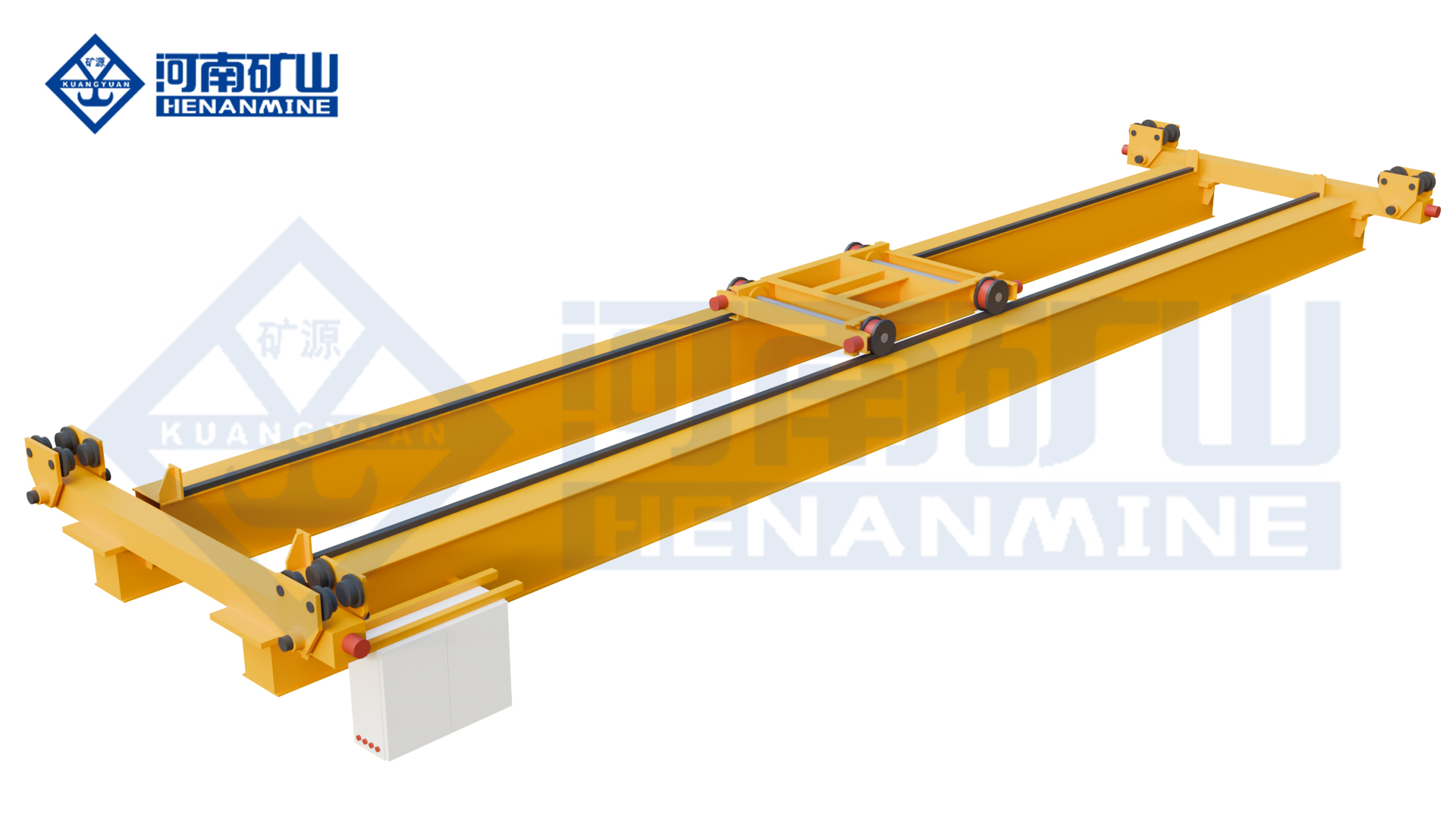
Henan Mine Crane ksqx double-girder suspension crane showing the primary crane structure and lifting arrangement.
The KSQX new-type electric double-girder suspension crane uses two parallel main girders connected to end girders by high-strength bolts. The crane hangs directly from roof-mounted tracks, eliminating floor crane supports and preserving production space.
For procurement, the building structure is part of the crane system. Roof-truss capacity, suspension points, runway deflection, hook coverage and any optional side cantilever must be reviewed together with crane capacity and duty.
Quick Specifications
| Product Model |
KSQX |
| Type-Test Product Name |
General Overhead Crane |
| Lifting Capacity |
Configured according to project requirements |
| Span |
Configured according to runway center distance |
| Lifting Height |
Configured according to workshop / process requirements |
| Working Duty |
Configured from source data and actual load spectrum |
| Lifting Attachment |
Configured according to the product and load |
| Control Method |
Configured according to project requirements |
Best For: For workshops that need a double-girder underhung crane suspended from roof tracks, clear floor space and modern motion / monitoring functions.
Request A KSQX Double-Girder Suspension Crane Quote
Product Overview
Two parallel main girders connected to end girders by high-strength bolts.
Crane includes travel mechanism, hoisting mechanism, electrical system and conductor system.
Directly suspended from roof tracks without ground support.
Where the source page does not publish a numerical capacity, span, speed, duty, positioning accuracy or other guaranteed performance value, the final value should be selected and agreed from the actual project rather than copied from a similar crane.
Why Choose KSQX Double-Girder Suspension Crane?
Clear Floor Space
Roof-suspended crane eliminates floor-mounted runway columns in the working area.
Double-Girder Suspended Capacity Platform
Provides a heavier underhung structure than a basic single-girder suspension crane.
Low Headroom / Hook Approach
Compact design improves usable building space.
VFD + Anti-Sway
Smooth motion supports higher-precision handling.
Optional Cantilever
Extends hook coverage beyond the nominal span when the building structure allows.
Remote Diagnostics
Supports monitoring and fault-diagnosis expansion.
Product Images

Source image associated with the KSQX Double-Girder Suspension Crane, showing the roof-suspended crane or installation.
|

Source image associated with the KSQX Double-Girder Suspension Crane, showing the roof-suspended crane or installation.
|

Source image associated with the KSQX Double-Girder Suspension Crane, showing the roof-suspended crane or installation.
|
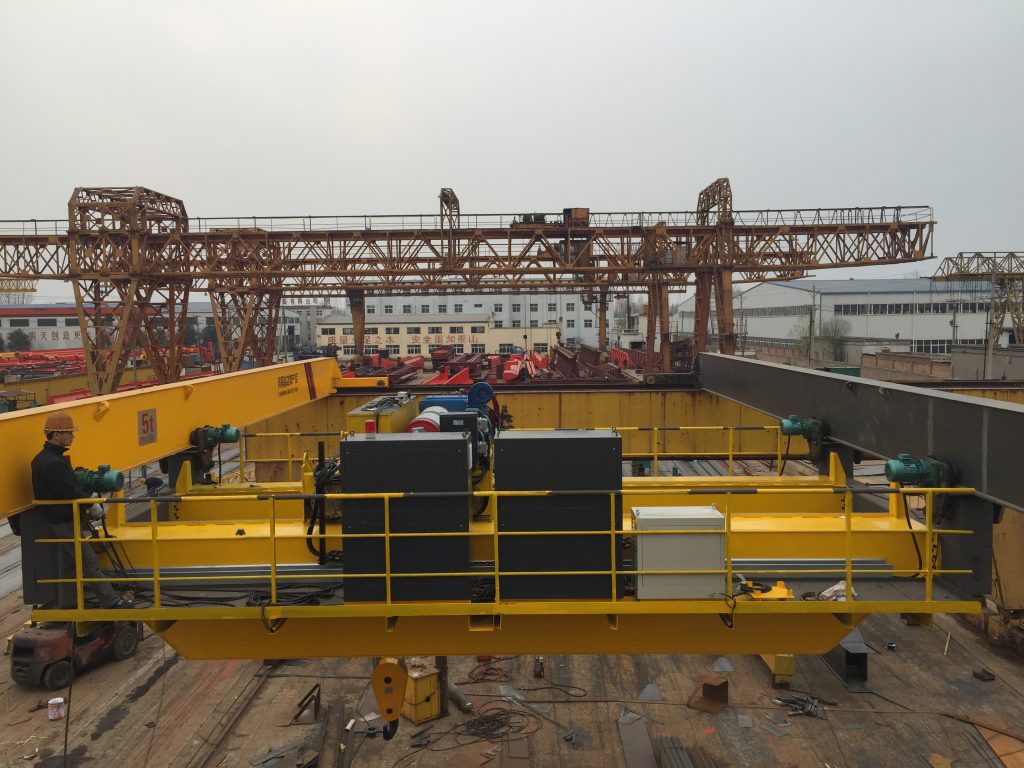
Source image associated with the KSQX Double-Girder Suspension Crane, showing the roof-suspended crane or installation.
|
Main Crane Components
| Bridge Structure |
Engineered from capacity, span, duty, runway and product-specific process loads. |
| Hoisting / Trolley System |
Configured for the product's lifting mechanism and operating cycle. |
| Lifting Attachment |
Selected from the actual load geometry, material and process. |
| Travel System |
Bridge and trolley travel selected for required speed, duty and positioning. |
| Electrical & Control System |
Configured for operator control, safety functions and any source-supported automation / monitoring. |
Technical Parameters
| Model |
KSQX |
| Product Type |
KSQX New-Type Double-Girder Suspension Overhead Crane |
| Type-Test Product Name |
General Overhead Crane |
| Capacity |
Project-specific unless source-stated above |
| Span |
Project-specific unless source-stated above |
| Lifting Height |
Project-specific |
| Hoisting Speed |
Project-specific |
| Trolley / Crane Travel Speed |
Project-specific |
| Working Duty |
Project-specific unless source-stated above |
| Control Method |
Project-specific |
| Power Supply |
According to site electrical conditions |
| Operating Environment |
According to actual process conditions |
Source-Confirmed Features & Buyer-Defined Options
Source-confirmed product facts:
- Two parallel main girders connected to end girders by high-strength bolts.
- Crane includes travel mechanism, hoisting mechanism, electrical system and conductor system.
- Directly suspended from roof tracks without ground support.
- Source lists VFD speed control, electronic anti-sway and high positioning accuracy.
- Overload protection, limit protection and emergency stop are source-listed.
- Optional side cantilever can extend working range beyond the span.
- Lightweight compact design reduces building load and construction cost according to source.
- Source highlights low headroom, small hook-to-wall distance, remote monitoring and fault diagnosis, plus intelligent-function expansion.
Buyer-defined items:
- Capacity and total suspended load
- Span / lifting height / runway length
- Load geometry and lifting attachment
- Operating frequency and working duty
- Control and safety functions
- Positioning / synchronization / automation where applicable
- Installation, testing and commissioning scope
Application Scenarios
| Production Workshops |
Floor-free overhead lifting. |
| Assembly Areas |
Precise handling with anti-sway. |
| Buildings with Fixed Floor Layout |
Roof suspension avoids crane columns. |
| Extended Coverage Bays |
Optional cantilever beyond the normal span. |
How to Select the Right KSQX Double-Girder Suspension Crane
1. Verify Roof Structure
Provide roof-truss, support-beam and allowable-load data.
2. Define Suspension Points / Runway
Track layout and support spacing control building loads.
3. Define Hook Coverage
Include any required cantilever beyond the span.
4. Check Headroom
Provide roof, runway and highest hook elevations.
5. Define Positioning / Monitoring
State required anti-sway, positioning and remote-diagnostics scope.
Building Integration for a Suspension Crane
| Roof Loads |
Crane wheel/support loads must be coordinated with the building engineer. |
| Suspension Points |
Define exact support locations and structural steel. |
| Cantilever |
Optional coverage beyond the span changes support reactions and must be calculated. |
| Headroom |
Use the actual workshop cross-section to evaluate hook height. |
Safety & Control: What Buyers Should Confirm
• Rated capacity, overload protection and load-indication requirements
• Hoisting / travel limits, braking and emergency-stop requirements
• Attachment-specific safety such as magnet backup, grab interlocks, clamps or tandem synchronization where applicable
• Operator control method, visibility and safe access
• Anti-collision, anti-sway, positioning or automation requirements where required by the process
• Factory / site acceptance, load tests and project-specific functional tests
Installation & Maintenance
Before manufacture and installation, confirm runway span, rail / runway-beam condition, elevation, straightness, available headroom, power supply and erection access. Special attachments, multi-trolley systems, cantilevers, suspended runways and automated layouts should be coordinated with the workshop or yard drawing before production.
Maintenance should follow the supplied crane manual and actual duty. Inspection normally covers the hoisting mechanism, brakes, ropes, hooks / attachments, wheels, drives, fasteners, limits and electrical systems, with additional checks for magnets, grabs, clamps, sensors, encoders or automation hardware where fitted.
What Information Do We Need for a Quote?
| 1 |
Maximum suspended load |
| 2 |
Required span / working width |
| 3 |
Runway length |
| 4 |
Roof support locations / allowable loads |
| 5 |
Roof structural drawings |
| 6 |
Lifting height / available headroom |
| 7 |
Optional cantilever length |
| 8 |
Duty / cycles |
| 9 |
Anti-sway / positioning requirement |
| 10 |
Monitoring / fault-diagnosis scope |
| 11 |
Control method |
| 12 |
Power supply / destination |
Frequently Asked Questions
How is the final crane capacity selected?
Use the total suspended load, including the load itself plus any beam, grab, magnet, clamp, spreader or rigging that remains below the hook.
Can the capacity, span and lifting height be customized?
Yes, these values are project-specific unless a source range is explicitly listed on this page. Provide the workshop / yard data for engineering selection.
What should I provide for a faster quotation?
Provide load drawings or dimensions, maximum suspended load, span, lifting height, runway length, operating cycle, environment and the specific process function that makes this product necessary.
Can control and automation be customized?
Where the source supports PLC, VFD, positioning, WMS/MES/DCS or remote functions, the final scope should be defined from the buyer's interface and acceptance requirements.
How should source-reported performance numbers be treated?
They describe the source product configuration. Any value that matters contractually for a new project should be written into the technical agreement and acceptance plan.
Related General Overhead Cranes
QLC Lower-Rotating Electromagnetic Beam Overhead Crane
QJ Lower-Rotating Beam Overhead Crane
QZ Intelligent Grab Bucket Double-Girder Overhead Crane
QEN Grab & Hook Dual-Purpose Overhead Crane
QDXG Zinc Pot Maintenance Overhead Crane
Request A KSQX Double-Girder Suspension Crane Quote
Send your lifting load, span, lifting height, runway length, workshop or yard drawing, operating cycle, load geometry and special attachment / control requirements. Henan Mine Crane engineers will review the process and prepare a project-specific crane configuration and quotation.
Request A Quote | View Overhead Cranes